
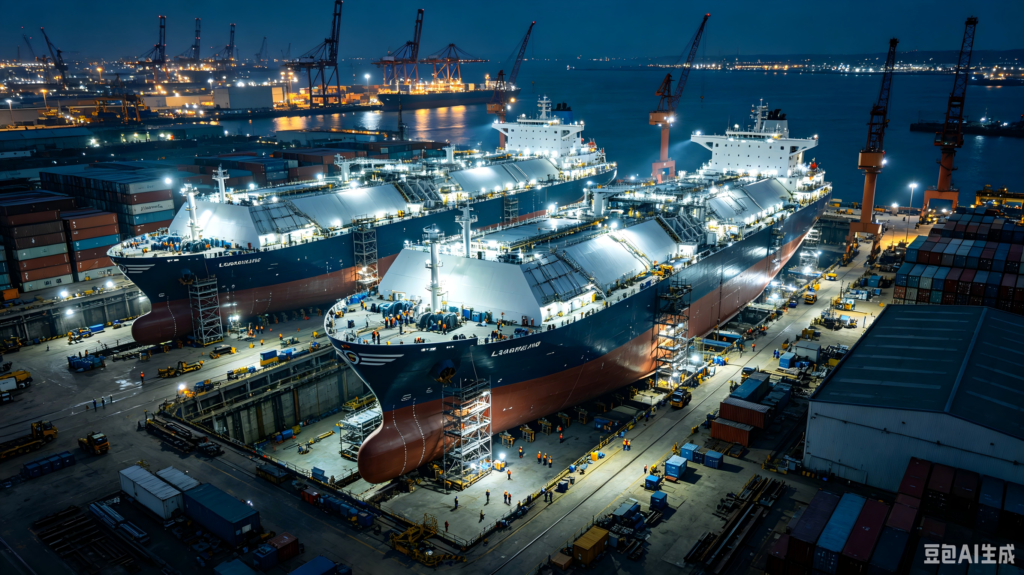
Battle for Shipbuilding Orders Heats Up! Intense Rivalry Between China and South Korea’s Shipbuilding Industries
A new round of competition for shipbuilding orders between China and South Korea has intensified. Chinese shipyards have retained the title of the world’s top order recipient for 14 consecutive months. Meanwhile, South Korean shipbuilders are catching up rapidly with strong performance in high-value-added vessel orders, narrowing the gap to merely 3 percentage points.
According to data released by Clarkson Research on June 9, global new ship orders in May totalled 147 vessels, equivalent to 4.52 million Compensated Gross Tonnage (CGT). Measured by CGT, the figure dropped 45% month-on-month but surged 91% year-on-year.
Chinese shipyards secured 97 new ships with a total CGT of 2.11 million, holding a 47% global market share and staying atop the global ranking for 14 straight months. South Korean shipyards took 34 vessels amounting to 1.99 million CGT, accounting for 44% of the global market. Combined, shipbuilders from the two countries captured 91% of global new ship orders in May, up 8 percentage points from 83% in April. The landscape of the global shipbuilding industry is increasingly defined by this two-power rivalry.
In terms of vessel numbers, China’s order volume was 2.85 times that of South Korea, while the CGT figure stood at 1.06 times. The average CGT per new ship for South Korea reached 59,000 in May, rising by 27,000 from the previous month. The average CGT per vessel for China was 22,000, a decrease of 6,000 month-on-month. This indicates that South Korean shipyards remain focused on constructing high-value-added vessels.
South Korean industry insiders stated that the country’s three major shipbuilders landed a large batch of high-value-added orders for LNG carriers, Very Large Gas Carriers/Very Large Ammonia Carriers (VLGC/VLAC) and ultra-large container ships in May. Samsung Heavy Industries won orders for 1 Floating Storage and Regasification Unit (LNG-FSRU) and 7 LNG carriers. HD Korea Shipbuilding & Offshore Engineering secured 11 VLGC/VLAC vessels, 6 ultra-large container ships and 4 LNG carriers. Hanwha Ocean received orders for 3 VLGCs and 2 LNG carriers.
Driven by these deals, South Korea’s market share climbed to 44% in May, just 3 percentage points behind China’s 47% — a sharp reduction from the gap of over 50 percentage points recorded in April.
In April this year, Chinese shipyards booked 156 vessels totalling 4.37 million CGT, taking a dominant 67% global market share. South Korean counterparts only obtained 33 ships with 1.05 million CGT, holding a 16% market share, resulting in a massive 51-percentage-point disparity between the two sides.
For the whole of last year, global new ship orders reached 2,036 vessels with a total CGT of 56.42 million. Chinese shipyards took 1,421 vessels (35.37 million CGT), holding a 63% market share. Although down from 71% in 2024, China still ranked first worldwide. South Korea came second, securing 247 vessels (11.60 million CGT) and a 21% global market share.
Chinese shipyards have maintained the world’s largest monthly order volume for 14 consecutive months since April last year.
From January to May this year, global cumulative new ship orders hit 1,108 vessels (33.56 million CGT), up 62% year-on-year from 863 vessels (20.66 million CGT) in the same period last year. Chinese shipyards took 816 vessels (22.98 million CGT) with a 68% market share, retaining the leading position. South Korean shipyards ranked second with 168 vessels (7.08 million CGT) and a 21% market share.
As of the end of May, the global order book stood at 200.2 million CGT, an increase of 3.79 million CGT from late April. China’s order book reached 129.43 million CGT, up 3.17 million CGT month-on-month, holding a 65% market share and keeping the top spot. South Korea’s order book was 37.06 million CGT, a month-on-month rise of 140,000 CGT, with a 19% market share to rank second.
Newbuilding prices continued to edge up in May. The Clarkson Newbuilding Price Index stood at 185.01, rising 1.6 points from 183.41 in April and nearly 3 points from 182.07 in March. It also represented a 36% increase compared with 136.1 recorded in May 2021, five years ago.
By vessel type:
- The price of 174,000-cubic-metre large LNG carriers remained unchanged month-on-month at 248.5 million US dollars.
- Very Large Crude Carriers (VLCCs) were priced at 130.5 million US dollars, also flat from April.
- Ultra-large container ships with a capacity of 22,000 to 24,000 TEU cost 261.5 million US dollars, an increase of 1 million US dollars from 260.5 million US dollars in April.