
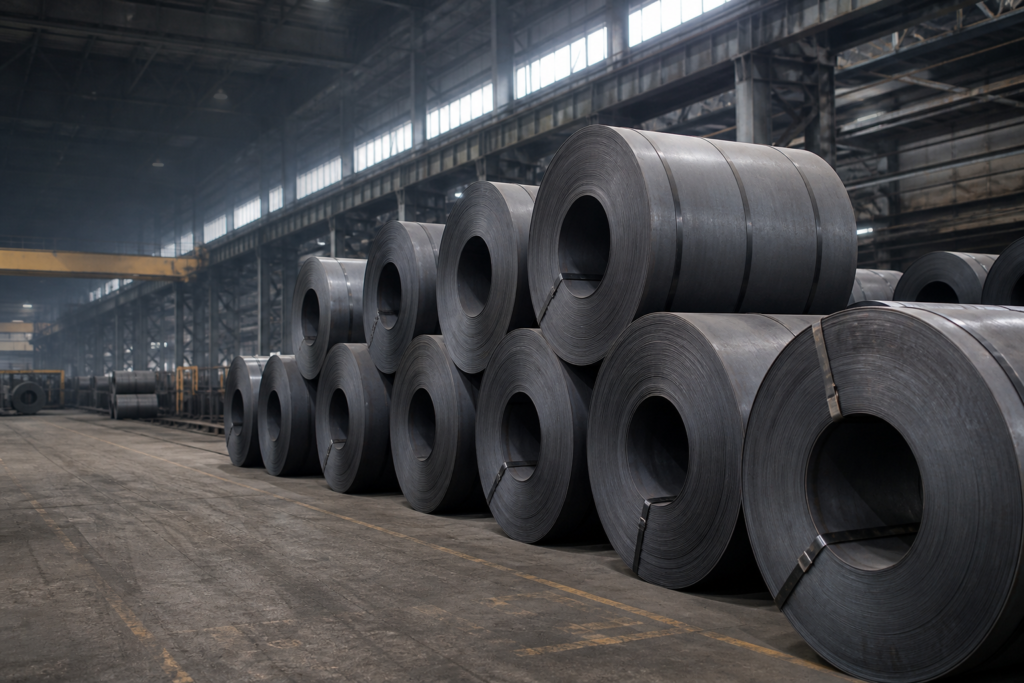
China Steel Supplier Outlook: Output Down 2.9% in 2026
China produced 724.77 million tonnes of crude steel in January–September 2026, down 2.9% year on year. The National Bureau of Statistics figures, carried by SteelOrbis on 19 October, put pig iron at 628.44 million tonnes (−3.0%) and finished steel at 1.0671 billion tonnes (−2.0%). The headline is a supply cut. The consequence for a European buyer is narrower: less export tonnage to allocate, and more of it going to buyers who can document it.
A Smaller Furnace Base, a Stubborn Export Flow
September separates the two trends. Crude steel output was 73.59 million tonnes, up 0.1% year on year but down 1.4% month on month; finished steel fell 3.8% year on year to 118.17 million tonnes, yet rose 3.0% month on month (SteelOrbis, citing NBS, 19 October 2026). Mills were not cutting their most saleable product.
Exports confirm it. China shipped 10.49 million tonnes of finished steel in September, up 0.26% year on year and the fifth straight month above 10 million tonnes (customs data via Mysteel, 14 October). January–September totalled 85.64 million tonnes, down 2.6% — a retreat, not a withdrawal.
Read together, the data describes a China steel supplier base trimming blast furnace volume while defending export utilisation. Crude steel down 2.9% against exports down 2.6% leaves little idle tonnage for a demand rebound. The surplus European buyers rely on is now decided less by Chinese capacity than by how much tonnage European customs will admit, and on what evidence.
In Europe, the Binding Constraint Is Clearance
The EU steel regulation in force since 1 July 2026 caps duty-free imports at 18.3 million tonnes a year, with a 50% duty above the quota (European Commission factsheet). Inside that ceiling, allocation is decided shipment by shipment.
Since 1 October it also depends on paperwork. Under Commission Implementing Regulation (EU) 2026/1963, importers of covered steel products must hold evidence of the country where the steel was melted and poured, plus the heat number, primarily through the mill test certificate. A transition period runs to 30 September 2027, during which alternative documents carrying both data points may be accepted (American Journal of Transportation, 22 September 2026).
Add the human variable. On 22 October the Koninklijke Staalfederatie reported that members see differences in how duties and quotas are applied in Italy and Spain compared with the Netherlands — there, on stainless products — and had lodged a complaint over a dossier covering around 26 product groups (EUROMETAL, 22 October 2026). Identical coils can clear at different cost and speed depending on the port of entry.
A documented tonne with a heat number and known melt origin is now worth more than a cheap one that stalls at the border.
What to Specify, Product by Product
Cold rolled coil for enclosures and appliances
For switchgear cabinets, refrigerator liners and appliance panels, yield is decided by surface consistency and dimensional discipline, not the grade label. Cold rolled steel coil in the DC01–DC04 and SPCC families is commonly supplied from 0.2 mm to 4 mm and 600 mm to 2,000 mm, subject to mill availability — see our cold rolled steel sheet and coil range. Fix coil ID, weight band and width tolerance in the purchase order; a 25 mm oversize on a 1,250 mm coil is scrap you have already paid freight on.
Plate and cut parts
For structural and machinery work, medium and heavy steel plate in the S235 and S355 families is commonly supplied from 8 mm upward, subject to mill availability (see general medium plate). Where the drawing is a bracket, base plate or gusset, buy the geometry instead: steel plate cutting parts cut to drawing remove nesting and secondary handling from your floor, and freight is charged on finished mass. The steel plate cutting parts page sets out cut and bevel options.
Traceability changes shape here too. On a plate order one heat number covers a bundle; on a cut-part order it must follow plate, nested component and packing list, or the chain breaks where a customs officer looks.
CRGO electrical steel
For transformer cores and EV traction motors, CRGO electrical steel is commonly supplied in 0.23 mm to 0.50 mm with coating options for lamination stacking, subject to mill availability — see the electrical steel category and the CRGO electrical steel product page. Core loss belongs to the specific heat, not the label. When a customer audits no-load loss, the certificate that matters is the one tied to the coil that was actually slit.
How We Would Book 2027 Tonnage
Ask for the mill test certificate before the quotation. A supplier that cannot show melt-and-pour country and heat number at enquiry stage will not produce a better one under schedule pressure. Request it for the exact grade and thickness you intend to buy, from the named mill — S355 from an integrated mill and S355 from a re-roller are not interchangeable in a customs file.
Separate the frame from the call-off. Agree annual volume with a documented price mechanism, then release monthly. That gives the mill reason to hold allocation while leaving room to adjust when a project slips.
Book ahead of the Lunar New Year window. Chinese mills schedule maintenance and export slots around the holiday; the weeks either side are the least forgiving moment to discover a heat number was never issued. First-quarter European tonnage is better confirmed in the fourth quarter.
Talk to Us Before You Fix Q1 Allocation
Q1 2027 tonnage is being committed now, and the rules that govern it are already in force. If you are weighing Chinese coil, plate, coated or electrical steel against European offers, send the specification — grade, thickness, width, coating mass, cut list if relevant, destination port — and we will return a landed-cost and document structure you can set beside your domestic quote. Contact us to start the comparison.
Sources
- SteelOrbis — China’s crude steel output down 2.9 percent in January–September 2026 (NBS data), 19 October 2026
- Mysteel — GACC: China’s steel exports top 10 million tonnes again in September, 14 October 2026
- GMK Center — Steel production in China fell by 2.9% y/y in January–September, 19 October 2026
- European Commission — Factsheet: EU steel measure
- American Journal of Transportation — EU ‘melt and pour’ evidence requirements from 1 October 2026, 22 September 2026
- EUROMETAL — Dutch Staalfederatie raises concerns over uneven customs treatment of steel imports, 22 October 2026