
Choosing Wear-Resistant Steel Plate: NM450 vs Hardox 450 vs NM500 — A Fabricator’s Selection Guide
Short answer
Hardness alone does not select a wear plate. Match the grade to the abrasion mechanism:
- Fine, sliding abrasion, low impact (chutes, hoppers, screens) → NM400 / 400 HBW class
- Mixed abrasion with moderate impact (buckets, truck beds, crusher liners) → NM450 / Hardox 450, 450 HBW class
- Heavy abrasion, coarse ore, high impact (primary crusher walls, ore pass liners, dredge parts) → NM500, 500 HBW class
Then ask the second question: who is going to cut it to my drawing? Because the grade decision is worth far less than the total cost of getting a wrong-sized part onto a machine.
Three duty classes, three hardness bands
Wear is not one phenomenon. The dominant mechanism decides the grade:
| Duty class | Dominant mechanism | Abrasive size | Practical hardness band |
|---|---|---|---|
| Light | Sliding abrasion, fines | < 5 mm | 360–400 HBW |
| Medium | Sliding + gouging, mixed feed | 5–50 mm | 400–450 HBW |
| Severe | High-stress gouging + impact | > 50 mm, coarse ore | 450–500+ HBW |
The practical test is not a laboratory one. It is a question about the surface that actually wears: is the wear face rubbing against fines, or is it being struck by coarse material at an angle? Sliding wear and gouging wear consume steel differently, and a plate chosen for the wrong one will be replaced before its hardness has had any chance to matter. When a buyer is unsure which class a machine belongs to, the useful inputs are the feed size, the drop height at the wear point, and how often the part is replaced today.
NM400 vs NM450 vs Hardox 450 vs NM500
| Grade | Hardness | Low-temp impact | Relative wear life | Weldability | Best-fit application |
|---|---|---|---|---|---|
| NM400 | 400 HBW | Good | Baseline | Good | Chutes, hoppers, screens, low-impact liners |
| NM450 | 450 HBW | Good | ~1.25× | Moderate | Buckets, truck beds, crusher liners |
| Hardox 450 | 450 HBW | Limited low-temp impact | ~1.25× | Moderate | Ambient-temperature general wear |
| NM500 | 500 HBW | Moderate | ~1.5–1.6× | Requires controlled practice | Ore pass liners, primary crusher walls, dredging |
Two practical notes that do not appear in most datasheets:
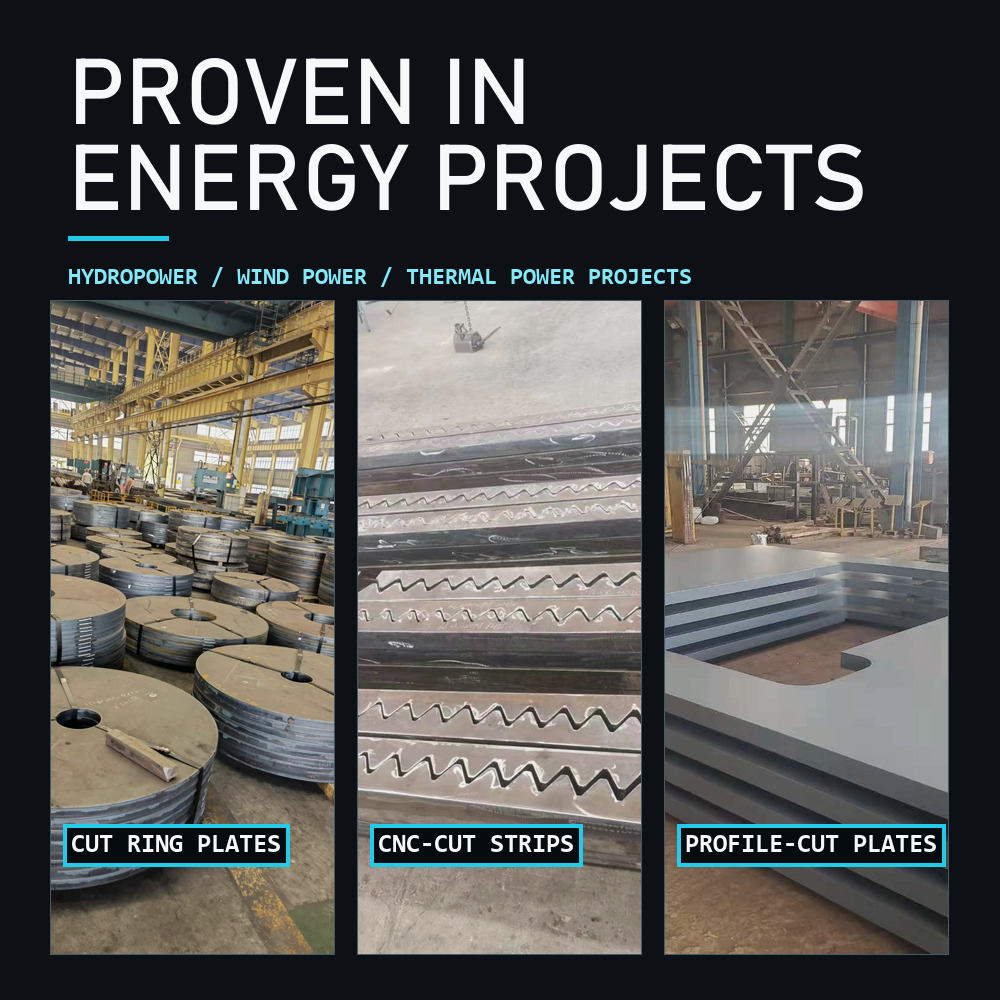
- Hardness is measured on the plate surface, not on your cut part. Laser or flame cutting introduces a heat-affected zone, and on a 500 HBW plate the HAZ can become the softest part of the finished component. This is why cutting method is a technical decision, not a purchasing decision — the cutting parameters have to be set for the grade so that the heat-affected zone stays narrow.
- Where the plate is welded to a structural member, toughness matters more than hardness. A 500 HBW plate welded to a stiffener with poor practice will crack at the weld toe long before it wears out.
The cost math most buyers miss: buying plate is not buying a part
Here is the calculation that changes the decision. A buyer compares plate prices per tonne, then discovers the real cost later.
| Cost line | Buying plate only | Buying cut-to-size from Nanjing Tiange |
|---|---|---|
| Plate cost | ✓ lowest per tonne | ✓ comparable |
| Cutting | Outsourced, separate supplier | Included — 20,000 W laser / CNC flame |
| Bevel / edge prep | Often forgotten | Included — precision bevel milling |
| Surface prep | Extra if needed | Included — large-scale shot blasting |
| Dimensional verification | Rarely done | 3D coordinate check, every batch |
| Rework risk | Buyer carries it | We carry it |
| Scrap from cutting errors | Buyer carries it | We carry it |
| Admin: 2 suppliers, 2 lead times | Buyer carries it | One order, one lead time |
The point is not that cut-to-size is always cheaper per kilogram. It is that the plate price is a small fraction of the cost of a part that fits. When you buy cut-to-size with verified dimensions, you are buying the removal of rework risk, and that is usually the larger number.
Fabrication capability behind the delivery
| Capability | Specification |
|---|---|
| Laser cutting | 20,000 W fibre laser |
| Flame cutting | CNC profile flame cutting |
| Surface preparation | Large-scale shot blasting line |
| Edge preparation | Precision bevel milling machines |
| Dimensional tolerance | ±1 mm |
| Surface roughness | Ra < 6.3 |
The capability list matters because of what it removes from your project. Parts that are cut, bevel-milled, blasted and dimensionally verified at one source do not need a second supplier, a second inspection gate, or a second party to argue with when a dimension is out.
Packaging: where rework cost actually comes from
Most complaints on wear plate are not about hardness. They are about rusty, edge-damaged plate arriving at the yard, which then needs re-blasting, re-cutting or rejection.
Packaging on our shipments:
- VCI vapour corrosion inhibitor — protects machined and blasted faces during sea and rail transit
- Moisture-proof industrial wrapping — the rail route through Manzhouli passes through large temperature swings, and condensation is the main enemy
- Cross-reinforced wooden pallets — resists the load patterns of rail handling, not just forklift handling
Packaging is specified as part of the order, not as an afterthought, because the cost of one damaged delivery is usually larger than the cost of doing it properly on every delivery.
Frequently asked questions
Can I use NM500 instead of NM450 everywhere, for longer life? Not generally. Higher hardness usually means lower toughness and more demanding welding, so on impact-loaded parts the failure mode shifts from wear to cracking. The correct answer is to match the grade to the dominant mechanism, not to the highest number on the datasheet.
Is NM450 a direct equivalent of Hardox 450? Equivalent in hardness class. Not equivalent in low-temperature impact performance, so for cold-climate installations they are not freely interchangeable.
Do you cut to drawing? Yes. Send a DXF, DWG or a dimensioned drawing and we will return a cutting and fabrication quote for the finished part, including the processing route.
What is the minimum order quantity? MOQ depends on the grade and on allocating a heat from the mill source, so it is confirmed per specification rather than quoted as a single number. Send the grade, the part and the quantity you need, and we will confirm the MOQ for that combination before you commit.
How do you handle delivery to Russia / CIS? Nanjing CR Express to Manzhouli and onward to major Russian ports and warehouses, with VCI packaging and documentation prepared for the technical requirements of the destination market.