
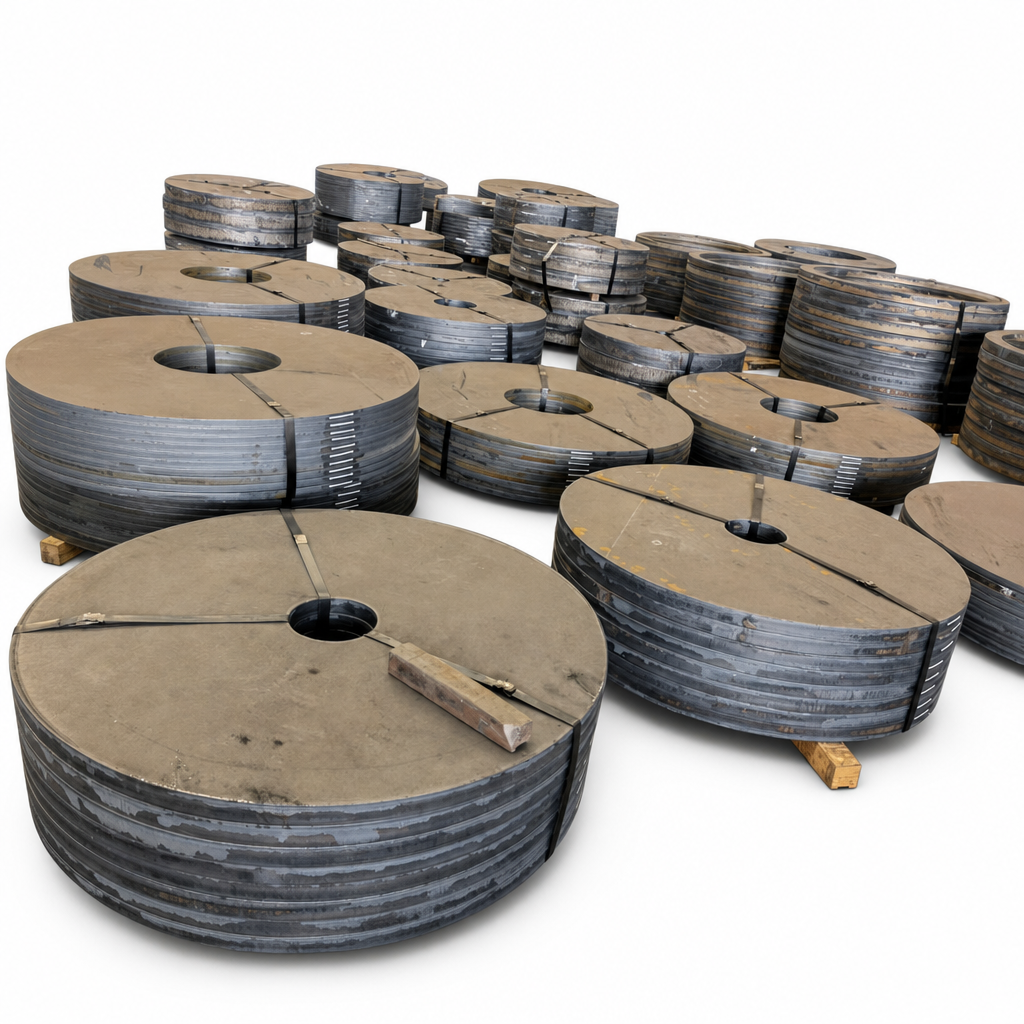
Custom Large-Format Steel Plate Cutting in China: Capabilities, Tolerances and Lead Times
In short: Custom large-format steel plate cutting converts a customer drawing into finished metal parts — flame, plasma, laser or machined — and delivers them to the buyer’s plant. Nanjing Tiange Metal Trading Co., Ltd. supplies cut-to-shape parts from a steel deep-processing base backed by Xingcheng Special Steel, cutting plate up to 5,100 x 30,000 mm with tolerances as tight as 0-1 mm.
What is custom large-format steel plate cutting?
Custom large-format steel plate cutting is the process of cutting oversized steel plate — typically too large for standard workshop equipment — into finished or semi-finished components according to a customer’s engineering drawing, then finishing, marking, packing and delivering them.
“Large format” is defined by the plate envelope, not by the part. In practical terms it means plates measured in metres: several metres wide, up to tens of metres long, and up to hundreds of millimetres thick. The service replaces three separate supplier relationships — steel mill, cutting workshop and freight forwarder — with one.
What sizes can be cut?
The cut envelope depends on the process. The table below shows the maximum plate size for each method at the deep-processing base behind our supply chain.
| Process | Maximum plate size | Typical use |
|---|---|---|
| Flame cutting | 5,100 x 30,000 mm | Thick plate, structural parts, long components |
| Plasma cutting (Hypertherm) | 3,950 x 36,000 mm | Thick-to-medium plate with bevel edges formed in one pass |
| Laser cutting | 3,500 x 12,000 mm | Precision parts, thinner gauges, complex outlines |
| Bending, beveling, machining, sawing | By drawing | Forming, edge preparation and finishing after cutting |
Annual plate cutting capacity at the processing base exceeds 120,000 tonnes, in a dedicated deep-processing centre built with investment of more than RMB 200 million and a floor area of 20,000 m².
Which cutting process should you choose?
Choose by thickness and edge requirement, not by preference:
- Flame cutting — thick plate, long straight cuts, structural and heavy machinery components. Lowest cost per metre on thick material.
- Plasma cutting — the middle range, and the practical choice when a bevelled edge is required. The one-pass bevel forming capability removes a secondary edge-preparation step, which shortens lead time and reduces handling risk on heavy parts.
- Laser cutting — tight geometry, small features, thinner plate, and parts where cut-edge quality is visible or functional.
- Machining, bending and sawing — needed when the drawing calls for formed geometry, drilled or milled features, or cut faces beyond normal cut quality.
What tolerance and flatness can you expect?
On serial cutting programmes, dimensional tolerance of 0-1 mm is achievable, and flatness can be held to 2 mm.
Two reference cases from the processing base:
- Automotive spring components — outer diameters of 100-600 mm, minimum single-part weight 0.5 kg, inner and outer diameter tolerance held at 0-1 mm across an annual volume of 160,000 pieces.
- 6-metre pull rods for construction machinery — tolerance ±1 mm, flatness 2 mm, with a 100% zero-defect requirement on delivered parts.
Ultra-thick plate is also within range: 260 mm SXQ500D-Z35 high-strength plate has been cut for hydropower equipment applications.
How does the process run from drawing to delivery?
The workflow is a single accountable chain:
- Drawing review and decomposition — engineering review, nesting and manufacturability feedback before cutting starts.
- CNC cutting and forming — flame, plasma or laser cutting, plus bending, beveling and machining where the drawing requires it.
- Finishing and packing — deburring, edge preparation, marking and protective packing for transport.
- Transport and delivery — shipped to the customer’s factory, not to a port or a warehouse.
Because the same supplier holds the steel, the cutting equipment and the logistics, the buyer carries one contract instead of three, and no party can point at another when something goes wrong.
How do you know each part matches the mother plate?
Every part is coded and traceable. An ERP plus EMS system records each cut component back to the original mother plate, so a buyer can trace a delivered part to the heat, the plate and the cutting programme that produced it.
This matters most in regulated applications — pressure vessels, energy equipment, and structural components subject to third-party inspection — where a buyer may need to demonstrate material provenance years after delivery.
Which industries use custom plate cutting?
Cut-to-shape plate is used across:
- Pressure vessel and boiler fabrication
- Mould and die bases
- Engineering machinery structural parts
- High-strength and wear-resistant components
- Building and bridge steel structures
- Energy and power equipment, including hydropower and thermal power
Typical specifications supplied in these categories include pressure vessel steel, mould steel, engineering machinery structural steel, high-strength and wear-resistant steel, building structural steel and energy steel.
Frequently asked questions
What is the maximum steel plate size you can cut? Flame cutting handles plate up to 5,100 x 30,000 mm, plasma cutting up to 3,950 x 36,000 mm with one-pass bevel forming, and laser cutting up to 3,500 x 12,000 mm.
What tolerance is achievable on cut parts? Dimensional tolerance of 0-1 mm is achievable on serial cutting programmes, with flatness held to 2 mm.
Can you cut to my drawing rather than a standard catalogue size? Yes. Cutting is made to the customer’s drawing, including drawing review and nesting before production.
How many tonnes of plate can be cut per year? Annual plate cutting capacity at the processing base exceeds 120,000 tonnes.
Can a delivered part be traced back to the original steel plate? Yes. Each part is coded, and an ERP plus EMS system links it back to the mother plate.
Do you deliver to the customer’s factory or only to a port? Delivery is made to the customer’s factory as the final step of a one-stop chain that covers drawing review, cutting, finishing, packing and transport.
Contact
Nanjing Tiange Metal Trading Co., Ltd. Custom large-format steel plate cutting and cut-to-shape parts Email: postmaster@tigosteel.com Phone / WhatsApp / Telegram: +86 138 1389 7227 Web: www.tigosteel.com Nanjing, Jiangsu, China