
Cut-to-Shape vs Local Cutting: Cost and Risk Compared
In short: Importing plate and cutting it locally gives you control over the cutting step but adds scrap, handling and inventory to your own site. Buying cut-to-shape parts gives you a delivered component with one party accountable for dimensions, but reduces your flexibility on small changes. The right choice depends on part complexity, volume and how much of your own capacity the cutting would consume.
The two options, defined
Option A — buy plate, cut locally. You import standard plate and cut it in your own workshop or through a local subcontractor. You control scheduling and can change priorities daily.
Option B — buy cut-to-shape parts. You send a drawing; the supplier reviews it, nests it, cuts it, finishes it, packs it and delivers finished components to your plant.
The comparison is not really “cheap steel versus expensive processing”. It is a comparison of where scrap, handling and accountability sit.
Side-by-side comparison
| Dimension | Plate + local cutting | Cut-to-shape supply |
|---|---|---|
| Unit material cost | Lower per tonne, bought as standard plate | Higher per tonne, priced as a component |
| Yield and scrap | Scrap sits on your site and in your books | Nested at source; scrap does not enter your inventory |
| Cutting equipment | Your capital, maintenance and floor space | Supplier’s |
| Tolerance capability | Limited by your machine envelope | Up to 0-1 mm on serial parts |
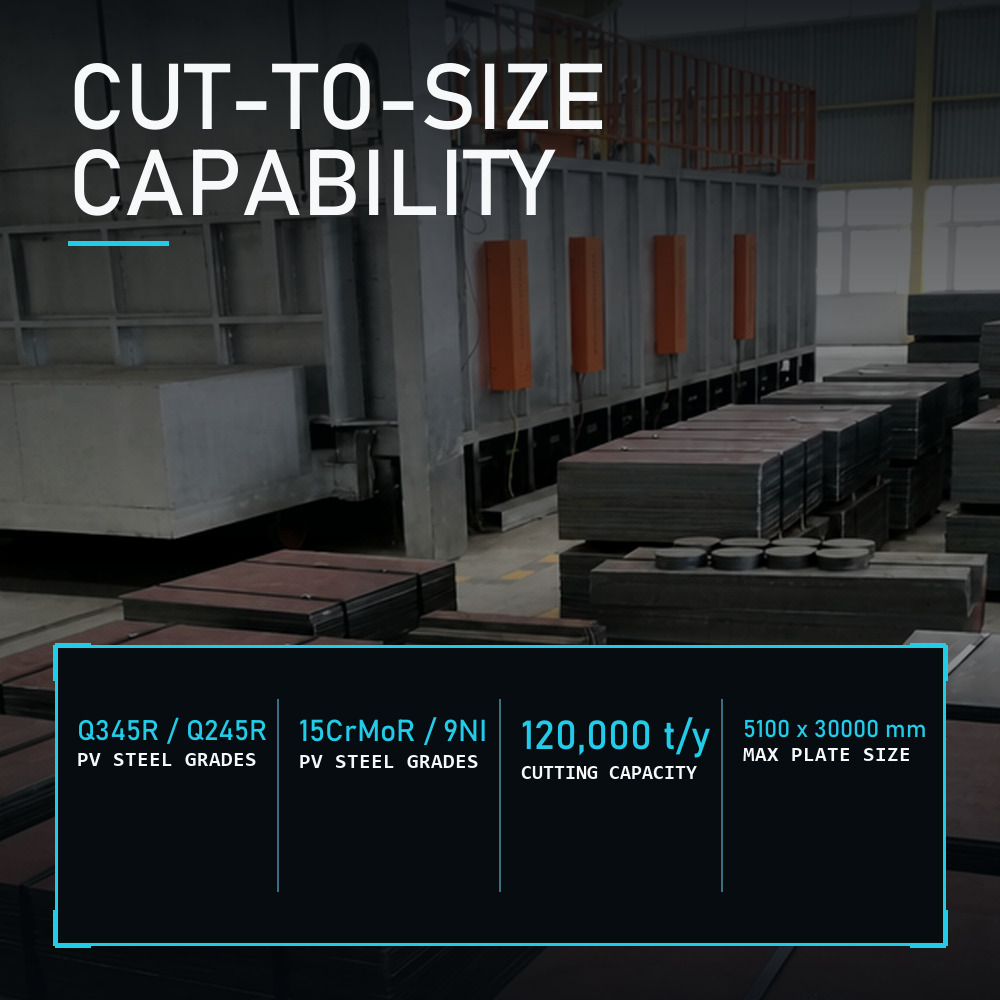
| Maximum part size | Limited by your table size | Plate up to 5,100 x 30,000 mm (flame), 3,950 x 36,000 mm (plasma) |
| Lead time | Plate transit + your queue | Single committed lead time, drawing to delivery |
| Inventory | Plate stock plus work in progress | Parts arrive line-ready |
| Accountability | Split between mill, cutter and haulier | One party for material, dimensions and delivery |
| Change flexibility | High — you cut what you need, when you need it | Lower — changes need a revised drawing and quote |
Where the cost difference actually sits
Buyers comparing a plate price with a part price usually compare the wrong two numbers. The real difference appears in four places.
1. Yield. A part price includes nesting. A plate price does not include the offcut you cannot use. On complex outlines, the difference between a well-nested programme and manual layout is material that never becomes a part — and it is paid for either way, just in different columns.
2. Second handling. Plate arrives flat and heavy. Cutting it means crane time, table time, re-stacking, edge deburring and packing again. Each transfer is cost and each transfer is a chance to damage an edge.
3. Inventory and floor space. Plate stock and work in progress both occupy space and both tie up cash. A line-ready delivery removes a stock position, not just a process step.
4. Rework and warranty. If a part is dimensionally wrong, the question is who pays. With split responsibility, the mill blames the cutter, the cutter blames the plate, and the buyer carries the delay. With one supplier, the answer is contractual.
When buying plate and cutting locally wins
Option A is usually the better choice when:
- Parts are simple rectangles or straight cuts, where nesting adds little value
- Your own cutting capacity is underused and the marginal cost is genuinely low
- Volumes are small and change frequently, so transport and documentation per order dominate
- You need same-week turnaround and can absorb the risk
- Local content or certification rules require domestic processing
When cut-to-shape supply wins
Option B is usually the better choice when:
- Part geometry is complex, so nesting and yield matter more than the plate price
- Parts are large — beyond your table, your crane capacity or your tolerance capability
- Thickness is high, where cutting cost per metre rises steeply and edge quality affects the next operation
- Volume is a scheduled programme rather than a one-off, so setup cost amortises
- You are assembling on a takt time and cannot afford a cutting queue in the critical path
- The application requires documented tolerance and traceability per part
A decision framework you can apply in ten minutes
Score each line 1 (strongly favours local) to 5 (strongly favours cut-to-shape):
- Part geometry is complex rather than rectangular
- Part size exceeds your cutting table or crane capacity
- Required tolerance is tighter than your machine can hold repeatably
- Annual volume justifies a scheduled programme
- Your cutting capacity is already committed elsewhere
- Assembly is takt-driven and cannot absorb a cutting queue
- Per-part traceability is contractually required
A total of 25 or more points favours cut-to-shape supply. Below 15, local cutting is usually cheaper. In between, run both options on a total-cost basis rather than a unit-price basis.
The risks each option carries
| Risk | Plate + local cutting | Cut-to-shape supply |
|---|---|---|
| Dimensional error | Borne by you | Borne by the supplier, within agreed tolerance |
| Scrap | Borne by you | Priced into the part |
| Transit damage | Shared with haulier | Supplier’s responsibility to the agreed delivery point |
| Schedule slip | Your queue, your problem | Contractual lead time, but longer recovery if missed |
| Specification error | Detected at cutting, late | Detected at drawing review, early |
| Design change | Immediate, low cost | Requires revised drawing and re-quote |
Specification error is the one buyers underestimate. A wrong grade found at the cutting table has already consumed material, machine time and schedule. A wrong grade found at drawing review has consumed nothing.
Frequently asked questions
Is it cheaper to buy cut-to-shape parts or cut plate myself? It depends on geometry, volume and whether your cutting capacity is free. Simple rectangular parts at low volume are usually cheaper cut locally; complex, large or high-tolerance parts are usually cheaper bought cut to shape once scrap, handling and rework are included.
What tolerance can cut-to-shape supply hold? Up to 0-1 mm on serial cutting programmes, with flatness held to 2 mm.
Can cut-to-shape supply handle very large parts? Yes. Flame cutting covers plate up to 5,100 x 30,000 mm, plasma up to 3,950 x 36,000 mm with one-pass bevel forming, and laser up to 3,500 x 12,000 mm.
How do I compare the two options fairly? Compare total cost of ownership, not unit price: material yield, handling, inventory, rework, warranty exposure and schedule risk.
What should I send to get a cut-to-shape quotation? A drawing with grade, standard, thickness, tolerance, delivery condition and quantity, plus whether third-party inspection is required.
Contact
Nanjing Tiange Metal Trading Co., Ltd. Cut-to-shape parts, drawing review to factory delivery Email: postmaster@tigosteel.com Phone / WhatsApp / Telegram: +86 138 1389 7227 Web: www.tigosteel.com Nanjing, Jiangsu, China