
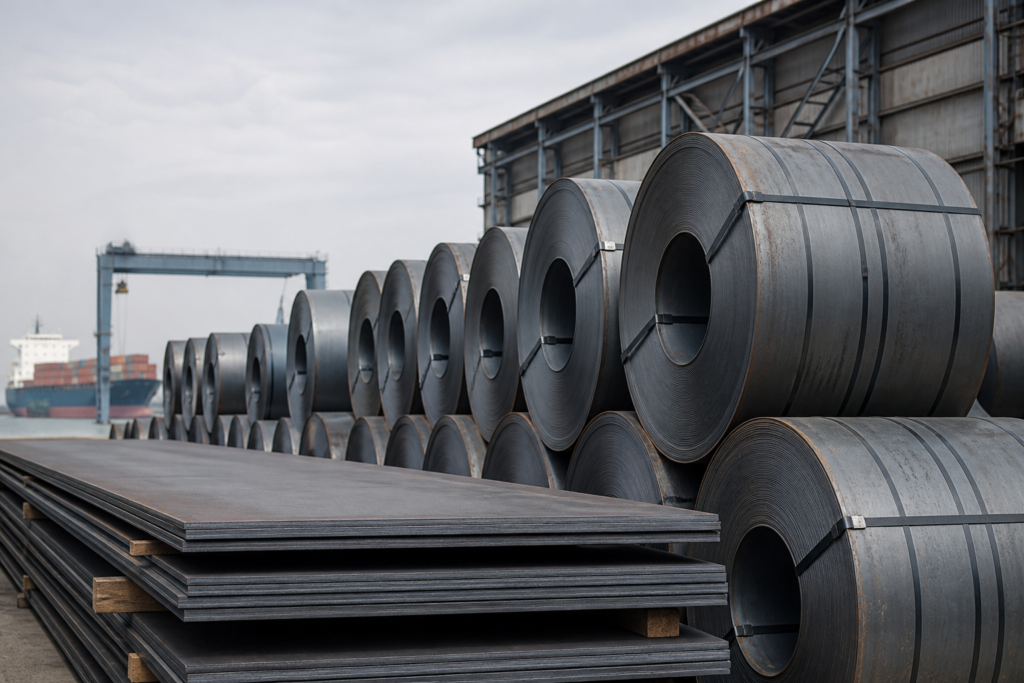
EU Steel Import Quota 2026: Melt-and-Pour Rule Explained
The European Union’s new post-safeguard steel regulation is now in force, and it changes the paperwork behind every steel coil and steel plate shipment entering Europe. The measure took effect on 1 July 2026 and covers steel imports from all third countries except Norway, Iceland and Liechtenstein. Since 1 October 2026, importers must be able to document the country where the steel was melted and poured.
For buyers of hot rolled coil (HRC), cold rolled steel coil, galvanized steel coil, medium and heavy plate and electrical steel, the practical question is straightforward: is your supply chain documentation ready for the next booking?
What changed, and when
- 1 July 2026 — the new measure entered into force, replacing the previous safeguard system and applying to imports from all third countries except the EEA states of Norway, Iceland and Liechtenstein.
- 1 October 2026 — the melt-and-pour requirement began. Importers must provide evidence of the country where the steel was originally melted and cast.
- Quota mechanics — the measure runs through tariff-rate quotas (TRQs). Unused quarterly volumes can be carried over within the same annual period and remain available for 20 working days into the following quarter.
- Future review — within two years the European Commission will assess whether melt-and-pour origin should become the basis for allocating tariff quotas by country.
Why melt-and-pour matters more than the headline tariff
A tariff is a number you can price in. An origin rule is a documentation risk you cannot fix after the vessel sails. If the mill certificate does not identify where the steel was melted and poured, the shipment can lose its quota treatment even when the steel itself is compliant.
In practice this means the mill test certificate now has to carry melt-origin information, not only the country of export. For traders and processors this is a purchasing-process change: origin data has to be requested at the quotation stage, not after production.
Quota and tariff pressure is building
Industry analysis of the regulation points to the available import quota falling sharply compared with 2024, with the out-of-quota tariff rising well above the previous level. The product scope is also widening — from 28 categories to at least 30, with certain wire products named as possible additions.
The consequence for planning is timing. Quotas can be exhausted faster than before, and once a category quota is used up, the higher out-of-quota duty applies to every importer in that category — whether or not they contributed to exhausting it.
Electrical steel: a second front opens
On 18 September 2026 the European Commission imposed provisional safeguard measures on imports of grain-oriented electrical steel, in the form of tariff-rate quotas coupled with price thresholds. Grain-oriented electrical steel is the input grade for transformer cores and lamination stacks, so the measure reaches transformer, motor and energy-equipment supply chains directly.
Other signals from the first week of October
- Japan scrap export tender (9 October) — Kanto Tetsugen awarded 20,000 t of H2 scrap at ¥52,077/t fas (about $329.15/t), up ¥3,964/t from September and above most market expectations.
- US anti-dumping review (6 October) — the US Department of Commerce set a preliminary anti-dumping margin of 13.11% on two Turkish rebar producers.
Taken together, both point to the same pressure: scrap-linked input costs stay firm while trade defence measures multiply across the two largest import markets.
What buyers should do before the next order
- Request melt-and-pour documentation up front. Ask for the country of melting and pouring with the quotation, and confirm it will appear on the mill certificate.
- Check quota availability for your CN code before booking. Do not assume last quarter’s allocation is still open.
- Reconsider just-in-time. With tighter quotas, availability is a bigger risk than carrying cost. A buffer in high-demand categories protects production schedules.
- Budget for CBAM. The carbon border mechanism has applied a carbon-related charge to steel imports since 1 January 2026 and stacks on top of duty.
- Lock specification and origin early. Origin flexibility is worth more than a small price difference when quotas are tight.
Sourcing steel coils and plate into the EU and North America
Nanjing Tiange Metal Trading Co., Ltd. supplies cold rolled steel coil, hot rolled coil and plate, galvanized and prepainted steel, low-alloy coil, medium and heavy plate and steel plate cutting parts, sourced from major Chinese mills including Baosteel, Angang and Wugang. We work with buyers across steel structure, switchgear, power transmission, automotive parts, appliances and cold-chain equipment.
If you need current availability, grades and lead times — and the documentation your customs broker will ask for — send us your specification or review our steel product range. For background on our supply capability, see our company profile.
Sources
- European Commission — Safeguard measures (including the 18 September 2026 provisional safeguard on grain-oriented electrical steel)
- Argus Media — EU’s post-safeguard steel measure set for 1 July start
- Accent Europe — EU steel imports are changing
- Argus Media — Japan’s scrap export tender rises in October (9 October 2026)
- Argus Media — US sets AD margins for 2 Turkish rebar firms (6 October 2026)