
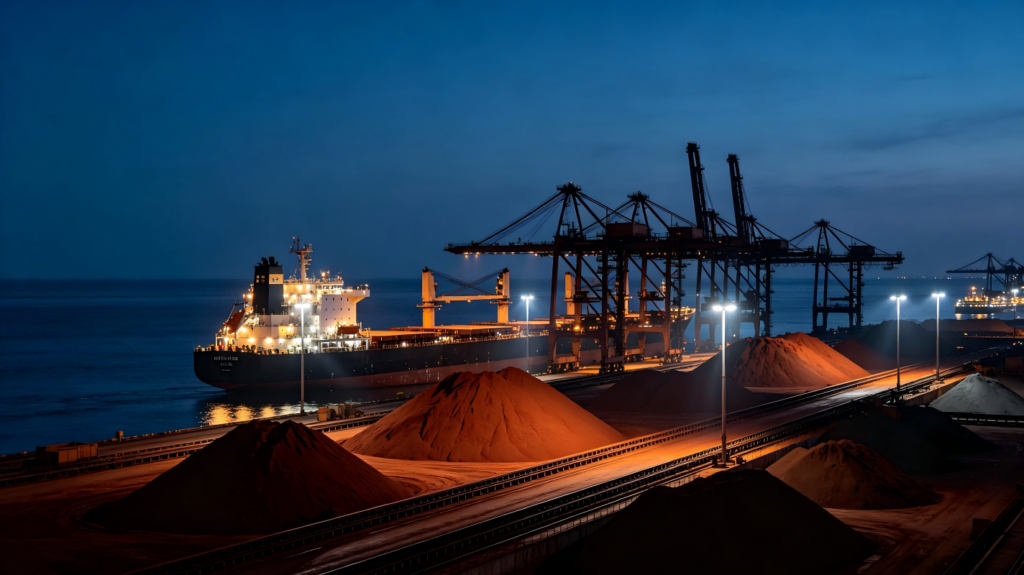
FMG’s Iron Ore Shipments Surpass 200 Million Tonnes for the First Time in FY2026; Long-Term Supply Talks with China Continue
Australian mining giant Fortescue Metals Group (FMG) recently released its fourth-quarter production report for fiscal year 2026, revealing that the company’s iron ore shipments hit a record high, exceeding 200 million tonnes for the first time in FY2026. Nevertheless, market attention remains focused on its negotiations with China Mineral Resources Group (CMRG) over a long-term iron ore supply contract. FMG stated it will keep advancing the talks with an attitude of “respect, patience and integrity”, stressing that current negotiating pressure stems from sustained margin compression at Chinese steel mills rather than a lack of willingness to cooperate on either side.
In early July this year, FMG and China Mineral Resources Group failed to reach an agreement on the long-term iron ore supply contract, sparking market concerns over potential tight supply of low-grade fines from Australia. However, the company’s latest report shows the negotiations have not disrupted shipment performance nor led to inventory build-ups. FMG’s full-year iron ore shipments for FY2026 reached 201.3 million tonnes, a year-on-year rise of 1%, marking the first time the 200-million-tonne threshold has been crossed. Shipments totalled 52.7 million tonnes in the fourth quarter alone. In Q4 FY2026, FMG’s Shanghai trading arm recorded port sales of 3.9 million tonnes, up from 3.8 million tonnes in the prior quarter, bringing full-year port sales to 16.7 million tonnes.
FMG acknowledged that China remains its most critical market, yet it has steadily expanded its global sales footprint in recent years. Southeast Asia stands out as a key growth region, while India is viewed as an emerging market with substantial future potential.
Dino Otranto, Chief Executive of Metals & Operations at FMG, noted during the earnings call that the root cause of pressure in talks with China Mineral Resources Group is the continuous squeeze on profit margins for Chinese steel producers. He added that if premiums for high-grade concentrates from the Iron Bridge project widen further down the line, FMG will consider ramping up output from Iron Bridge and cutting supply of hematite products accordingly to optimise its product mix.
Depressed profitability across steel mills and elevated concentrate inventories have weighed on pricing for FMG’s products. The discount on the miner’s flagship low-grade fines against the 61% iron ore fines index widened further in the second quarter, while Iron Bridge concentrates shifted from trading at a premium to the 65% fines index to a discount. Figures show the average realised price for hematite products in Q4 stood at US$88.85 per dry tonne, down from US$92.17 per dry tonne in Q3; Iron Bridge concentrates averaged US$118.20 per dry tonne, falling from US$121.76 per dry tonne in the previous quarter.
Ben Kuchel, Chief Sales & Marketing Officer at FMG, pointed out that bloated concentrate inventories across the global seaborne supply chain are a major factor suppressing prices of high-grade concentrates. Meanwhile, rising coking coal prices have eroded the competitiveness of low-grade ore, prompting the company to adjust discounts on hematite products to retain market competitiveness. Even so, FMG maintains that low-grade iron ore still enjoys solid demand amid persistently thin profit margins for steel mills, and its overall product portfolio remains competitive.
On the production front, FMG’s hematite shipments reached 192.3 million tonnes in FY2026, edging up from 191.3 million tonnes in the prior fiscal year. Shipments of Iron Bridge concentrates jumped 27% year-on-year to 9 million tonnes, with Q4 deliveries hitting 2.7 million tonnes, though the project’s ramp-up pace lags earlier forecasts.
FMG projects Iron Bridge shipments will range from 11 million to 14 million tonnes in FY2027, with plans to lift annualised capacity above 16 million tonnes by FY2028 — still short of the project’s 22-million-tonne design capacity. Overall iron ore shipment guidance for FY2027 is set at 197 million to 207 million tonnes, including 11 million to 14 million tonnes from Iron Bridge.
FMG also indicated future output growth will be constrained primarily by port loading capacity rather than mining and processing capacity. The company’s current annual port handling capacity stands at roughly 205 million tonnes, and it is exploring viable solutions to lift this figure to the permitted maximum of 210 million tonnes to support shipment growth in the years ahead.