
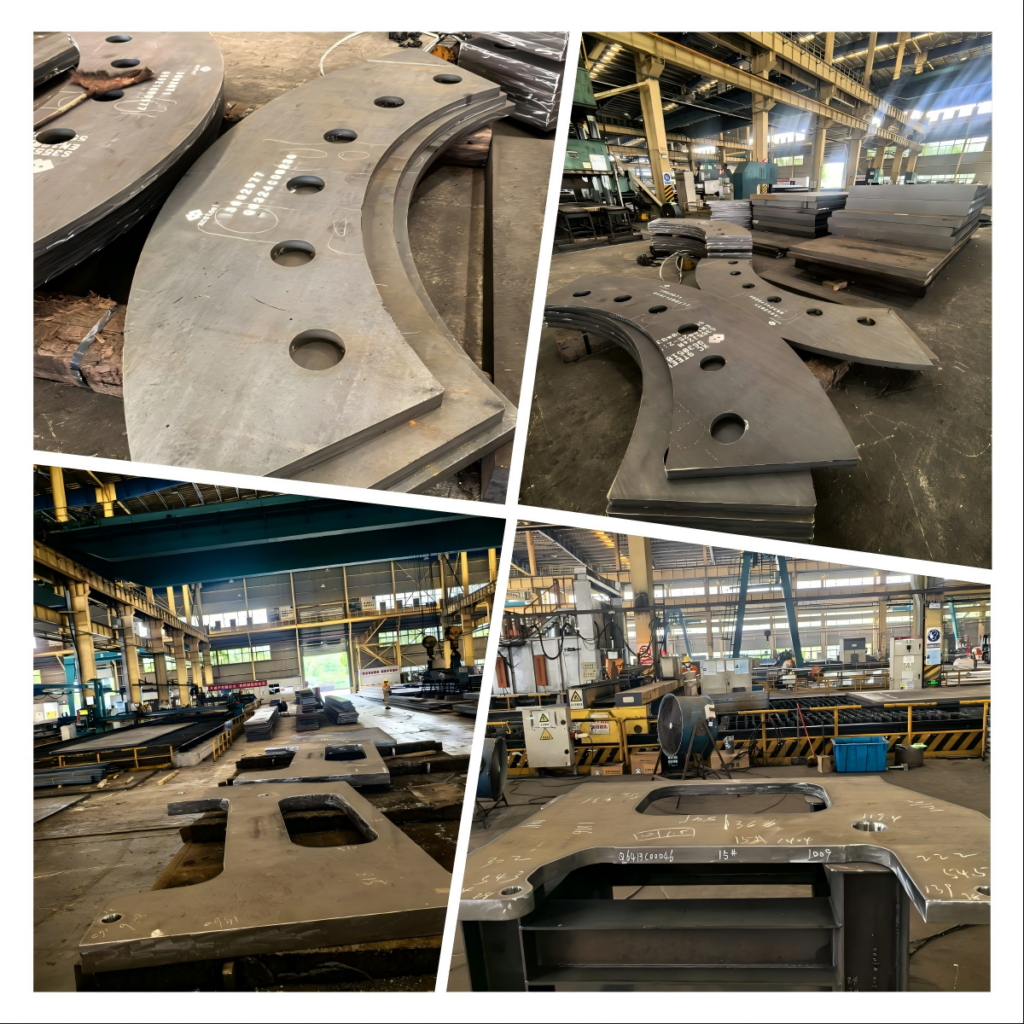
From Plate to Finished Part: Inside the Plate Extension and Processing Lines
Most steel suppliers stop at the plate edge. A plate extension line starts there. It takes mill plate and carries it through surface preparation, cutting, sawing, leveling, beveling, forming, fit-up, welding and machining until what leaves the facility is a semi-finished or finished component — not a sheet of steel.
The Wugang plate extension system was built for that purpose: to turn a wide, heavy plate mill’s output into parts that drop straight into a fabrication sequence. It runs as one main plate line plus four branch lines — forging, casting, structural fabrication and machining — which together move the product from “material” to “next-process input”.
The process chain
Plate work at the centre runs three route depths, depending on how far the customer wants to go:
Short route: pre-treatment → cutting or sawing → finishing → delivery as a cut part.
Medium route: the above, plus leveling, beveling and edge preparation — a part ready for welding without further dressing.
Long route: the full chain through bending, fit-up, welding and machining to a finished workpiece.
The unit operations available along that chain are: surface grinding, shot blasting, pre-treatment (blast + prime + mark), flame cutting, saw cutting, finishing, leveling, beveling, bending, fit-up, welding, and machining.
The logic is simple: every operation a customer does not have to perform is an operation that cannot introduce a dimensional error, a handling defect or a schedule delay in the customer’s own shop.
Production capacity by line
| Line | Output capability |
|---|---|
| Plate surface treatment | 200,000 t/year |
| Plate flame cutting | 50,000 t/year |
| Plate saw cutting | 20,000 t/year |
| Forging | 3,000 t/year of forgings |
| Casting — ingot moulds | 10,000 t/year |
| Casting — large castings | 10,000 t/year |
| Casting — small castings | 2,000 t/year |
| Structural components | 5,000 t/year |
| Machined components | 16,000 t/year |
Aggregate nominal capacity across these lines exceeds 300,000 t a year.
The system is designed around 14 steel series and more than 160 grades, with multiple specification options per grade — which is what makes a single processing route usable across a mixed order rather than forcing a new setup for every heat.
Line by line: what each one can actually take
Pre-treatment line
Grinding, shot blasting, priming and marking in one pass.
- Thickness: 8–120 mm
- Width: up to 4,200 mm
- Length: up to 16 m
Blast cleanliness reaches Sa 2.5; primer film thickness is controlled at 15–25 μm. For export jobs, this is the step that decides whether a plate arrives at site with surface rust or with a paintable surface.
Surface treatment line
Seven plate surface grinders and two shot-blasting units handle the defects that a mill surface can carry: pitting, mill scale, corrosion, and local thickness variation.
- Thickness: 40–600 mm
- Width: up to 4.2 m
- Single piece weight: up to 50 t
Cold cutting — CNC plate saw
A large CNC plate saw with a throat height of 800 mm and throat depth of 1,200 mm, travel of 10,000 mm and a 50 t table load.
- Cutting range: 8–300 mm thickness, up to 3 m width, up to 10 m length
- Achievable surface roughness: Ra 6.3
This is the line that solves the problem flame cutting cannot: grades where a thermal cut edge is a crack initiation site. It is used on H13 stainless, wear plate (NM400–NM500 / WRZ400), mould steel (P80 / P18 / P20), high-strength steel (Q690–Q1100), vessel-grade alloy steel (ESR 12Cr2Mo1R), rack steel (ZH70Q) and high-carbon steel (35#–55#).
Flame cutting line
Twelve CNC flame cutting machines, two CNC plasma machines, two self-propelled beveling machines and a dedicated heating-and-slow-cooling furnace for special grades.
- Base plate weight: up to 50 t
- Profile parts: up to 420 mm thick
- Straight cuts: up to 600 mm thick
- Width up to 4.2 m, length up to 16 m
- Plasma covers stainless and non-ferrous plate
- Constant-temperature cutting furnace: 2,700 × 9,000 mm
Computer nesting and a computerised quoting system drive material utilisation and price transparency on cut parts — the difference between a quoted yield and an actual yield on a job with many shaped components.
Beveling
Multiple bevel units plus a robotic flame beveling machine covering straight and profile work up to 150 mm thick, within 2 m × 10 m. Manual semi-automatic beveling handles over-length straight bevels. Single-sided and double-sided bevels are both standard.
Leveling
A large nine-roller leveler addresses the defects that show up after cutting: plate crown, out-of-flatness, and distortion in large flame-cut parts.
- Thickness: up to 40 mm
- Width: up to 2,200 mm
- Yield strength: up to 700 MPa
- Resulting flatness: within 2 mm/m
- Capacity: 20,000 t of plate and cut parts per year
Forging line
1 t and 3 t electro-hydraulic hammers, a 560 kg air hammer, a 25 MN quick forging press, a ring-rolling machine and four gas-fired heating furnaces.
- Rings: up to Ø1,000 mm
- Shafts: up to Ø350 mm
- Blocks: up to 600 × 600 mm
- Single piece weight: up to 1 t
The line holds a Chinese special-equipment manufacturing licence for pressure piping components.
Casting line
A 100 t ultra-high-power electric arc furnace with VD, an LF refining furnace, a 5 t induction melting furnace, a 100 t gas annealing kiln, 20 t/h automatic sand reclamation, a 15 t/h continuous mixer, a 5.5 × 4 m vibrating table, two large ingot-mould machining centres and a modern pattern shop.
Output covers ingot moulds, forging dies, slag pots, bottom plates, base plates, trumpet tubes, hot tops and other metallurgical tooling, plus custom castings — more than 20,000 t a year. A separate steel, copper and ductile-iron casting line produces pieces up to 4 t at around 2,000 t a year. Drawing on the 90 t electric furnace at Wugang, castings above 100 t are also achievable.
Structural fabrication line
34 sets of welding equipment including submerged-arc machines, a 4 m automatic welder, roller surfacing units, a sand blasting unit, TIG and MIG sets. Capability covers large metal structures, pressure-vessel steel and special-steel welding.
Machining line
165 machines including a CR61125 lathe, C534J vertical lathe, XH2425 CNC gantry boring and milling centre, XL2016 digital gantry mill, M7150 surface grinder, M1350Q cylindrical grinder, TK6920 and TK6516 CNC boring and milling machines, and a Y31200 gear hobbing machine.
| Feature | Envelope |
|---|---|
| Flanges | Ø ≤ 3,400 mm, thickness ≤ 1,600 mm |
| Shafts | length ≤ 8,000 mm, Ø ≤ 900 mm |
| Box-type parts | 7,900 × 1,800 × 3,800 mm |
| Gantry centre (XH2425) | 3,200 × 1,750 × 8,000 mm, table 2,500 × 8,000 mm, 30 t load |
| Boring mill (TK6920) | spindle Ø200, ram travel 1,200 mm, vertical 4,000 mm, column travel 8,000 mm, rotary table 3,000 × 2,500 mm, 30 t load |
| Surface finish | Ra 3.2 for gear cutting, Ra 1.6 for other machining |
What this changes for a buyer
A purchaser comparing quotes on a heavy component is usually comparing three different business models without realising it: a plate trader, a cutting shop, and an integrated processor. They look similar on a price sheet and behave very differently on a project.
The integrated route changes four things:
Tolerance ownership. Cut-part accuracy at or better than the national standard, with surface roughness of Ra 12.5–50 on flame-cut faces, is a stated output rather than an aspiration. When the same organisation controls the plate and the cut, tolerance does not accumulate across a supply chain.
Grade-appropriate process selection. The choice between saw cutting and flame cutting, between cold and heated cutting, between leveling before or after beveling, is made on the shop floor by people who cut these grades daily. That is why 35#–55# high-carbon plate and 12Cr2Mo1R vessel steel do not arrive with cracks.
Supply envelope. Deep processing covers 8–600 mm thickness, ≤4.6 m width, ≤17 m length, for square and profile parts across all grades in the programme. That covers most heavy fabrication requirements without a second supplier.
One drawing, one delivery. The stated goal of the extension programme — 50,000 t of processed parts a year — is built on a single promise that is unusually direct for this industry: you supply the drawing, we do the rest. Send it to postmaster@tigosteel.com or WhatsApp +86 138 1389 7227, and the reply covers the process route and the delivery window together.
FAQ
What is the difference between a plate extension line and an ordinary cutting shop? A cutting shop buys plate and cuts it. An extension line is attached to the mill that rolls the plate: material, heat treatment, cutting and machining sit inside one quality system, and the process route can use equipment sized for mill-scale plate — 600 mm flame cuts, 300 mm saw cuts, 50 t table loads.
Can you process plate supplied by the customer? Yes. Customer-supplied plate can be routed through the same operations, subject to incoming inspection and a documented condition report before cutting begins.
How is a mixed order handled — several grades, several thicknesses, one project? Process routes are planned per grade and per thickness, then sequenced so that shared operations (blasting, priming, marking) batch where possible. On a mixed vessel-and-structure package this is usually where the schedule is won or lost.
What tolerance should be expected on a flame-cut profile part? Cut-part accuracy meets or exceeds the applicable national standard, with flame-cut surface roughness in the Ra 12.5–50 range. Tighter requirements are achievable through saw cutting or machining, and are quoted as a separate operation.
Is flatness guaranteed after cutting? Leveling on the nine-roller machine brings plate and cut parts up to 40 mm thick and 2,200 mm wide — at yield strengths up to 700 MPa — to within 2 mm/m. Parts outside that envelope are assessed individually.
Contact Nanjing Tiange
Send the grade, the dimensions, the drawing or DXF, and the required date. You get back a process route, a tolerance statement and a delivery window — the part, not just the plate.
Nanjing Tiange Metal Trading Co., Ltd. Mill-direct steel supply with full certificate traceability
- Email: postmaster@tigosteel.com
- Phone / WhatsApp / Telegram: +86 138 1389 7227
- Web: www.tigosteel.com
- Location: Nanjing, Jiangsu, China
About us. Established in March 2016 in Nanjing, Jiangsu, Tiange supplies Wugang and Angang heavy plate and Baosteel, Maanshan and Panzhihua cold-rolled and coated coil, and processes plate into cut, beveled, leveled, welded and machined components through the Wugang plate extension lines. Mill-direct supply with full certificate traceability — from heat number to finished part.
Fastest route for a live job: WhatsApp +86 138 1389 7227 with a photo of the drawing and the grade you need.