
From the World Top 500 Steel Companies List: Reshaping the Development Logic of Chinese Steel Enterprises in the 15th Five-Year Plan
Released on July 28, 2026, the Fortune Global 500 ranking featured three noteworthy figures: total revenue of listed companies hit USD 43.1 trillion, a year-on-year rise of 3.2%; the threshold for inclusion climbed from USD 32.2 billion to USD 33.2 billion; combined net profit of the 500 firms reached USD 3.4 trillion, up 14% year-on-year and setting a new all-time high. The world’s top 500 corporations earned more profits last year than at any point in history.
For the steel sector, 14 global steel enterprises made the list, among which 10 are Chinese steelmakers (excluding steel-involved conglomerates such as CITIC Group, China Minmetals Corporation and Shaanxi Coal Industry Group). While Chinese steel firms dominate in headcount, their profit margins remain extremely thin, and some even reported substantial losses. By contrast, ArcelorMittal of Luxembourg posted revenue of only USD 61.35 billion yet achieved a profit margin of 5.1%, with net profit at USD 3.152 billion.
This ranking lays bare a stark reality: the competitiveness crisis facing China’s steel industry is no longer a multiple-choice question of whether to develop high-end products. Instead, it has become an existential challenge of whether enterprises can survive. During the 15th Five-Year Plan period, Chinese steel companies must shift from volume-driven expansion to value creation, accelerate the reshaping of their development logic, and boost core competitiveness — and time is of the essence.
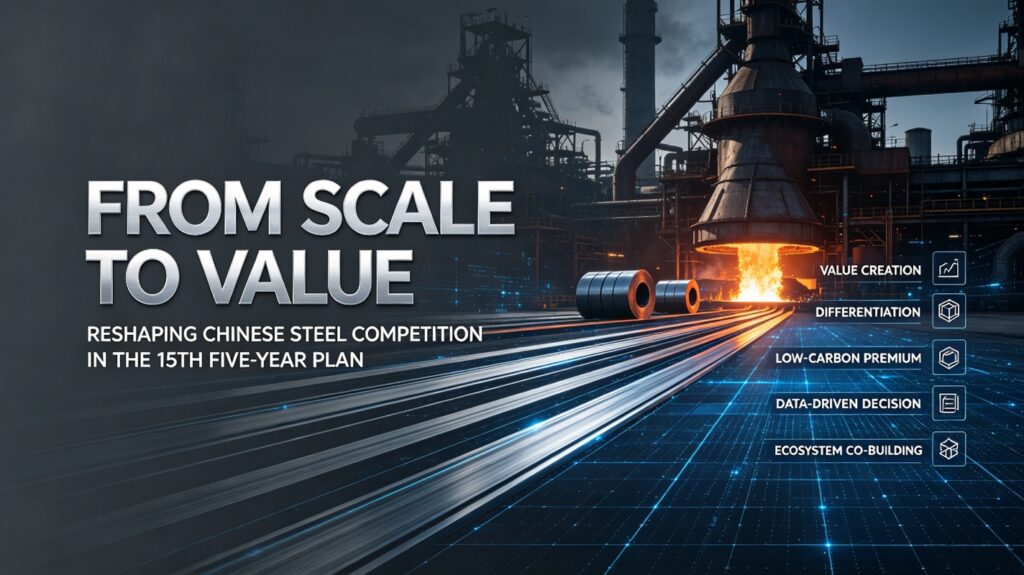
- Shift from “scale expansion and offsetting price declines with higher output” to “value creation and winning by quality”
- Shift from “homogenized, mass-market production” to “differentiated, customized solutions”
- Shift from “high-carbon production with cost priority” to “low-carbon production and green premium capture”
- Shift from “experience-driven, black-box manufacturing” to “data-driven, intelligent decision-making”
- Shift from “product export and isolated operation” to “value export and ecosystem co-construction”
Five Pressing Imperatives for Chinese Steel Enterprises to Boost Competitiveness
The urgency for Chinese steelmakers to lift competitiveness stems from five irreversible trends:
First, thin margins and even losses have touched the industry’s survival baseline. In 2024, key steel enterprises recorded an average sales profit margin of merely 0.71%. The figure rebounded to 1.9% in 2025 and stood at 1.92% in H1 2026. Specifically for the core steel business, profits totalled only CNY 16.7 billion in the first half of this year, plunging 40% year-on-year with a profit margin of just 0.77%. Profit per tonne of steel fell below CNY 100, and “higher output without higher profits” has become commonplace. A considerable number of firms suffered periodic losses; some zombie enterprises rely on continued local bank lending to stay afloat, and a negative cycle of “low prices → losses → debt” is solidifying for many operators. Without competitiveness, survival itself becomes uncertain.
Second, carbon costs have evolved from an environmental variable into a rigid constraint determining corporate survival. 2026 marks the first compliance year after the steel sector’s inclusion in China’s national carbon market. Outdated long-process steel mills face an additional carbon cost of CNY 140–180 per tonne of steel. The EU Carbon Border Adjustment Mechanism (CBAM) has erected a “carbon wall”. Plain carbon steel produced via long-process routes may be completely locked out of the EU market due to steep CBAM costs. ArcelorMittal benefits from a 25% share of electric arc furnace (EAF) steel production and has captured the CBAM green premium, pushing its profit margin from 2.1% to 5.1%. Steel enterprises lacking low-carbon competitiveness risk losing access to the entire EU market.
Third, demand structure is undergoing a fundamental shift, and traditional markets are contracting. Amid the long-term downturn in the real estate sector, demand for construction steel will not return to past highs. In 2025, construction steel consumption dropped to a historic low of 48% of total steel demand. Meanwhile, emerging sectors including new energy vehicles, wind and solar power plus energy storage, and high-end equipment are triggering a “steel demand revolution”. Demand for high-grade non-oriented electrical steel used in drive motors of new energy vehicles is rising exponentially. Commercial operation of the C919 large passenger aircraft has spurred surging demand for aviation-grade superalloys and ultra-high-strength special steel… Steelmakers that fail to keep pace with shifting demand patterns will be eliminated by the market.
Fourth, international competitors are accelerating their transformation. POSCO Holdings builds its business on steel, with operations covering new materials, new energy, construction and IT. It has retained the global No.1 ranking in the World Steel Dynamics (WSD) list of the world’s most competitive steel companies for 14 consecutive years. In July 2026, it released its “Triple Core” strategy targeting consolidated revenue of 187 trillion KRW by 2035. ArcelorMittal doubled its profit margin by “scaling down capacity, improving efficiency and capturing green premiums”. While Nippon Steel suffered a sharp short-term profit drop from its acquisition of U.S. Steel, its global footprint has been strengthened and its technology reserves remain robust. If Chinese steel firms cannot speed up their efforts in this global race, the gap will only widen.
Fifth, global trade barriers keep tightening, and traditional export channels are narrowing. In 2025, China’s steel exports hit a record high of 119 million tonnes, yet the average export price slid to USD 694 per tonne, with nearly 29 trade friction cases filed throughout the year. Low-efficiency mills concentrate on exporting low value-added products such as steel billets and ordinary carbon steel. The average export price of steel billets is 20%–30% lower than finished steel products, resulting in nearly CNY 10 billion in lost value-added every year. The strategy of relying purely on exports to digest excess capacity faces triple pressure: “rising volume accompanied by falling prices → anti-dumping and countervailing duties → carbon tax restrictions”, rendering it unsustainable.
These five overlapping pressures constitute the fundamental driver for Chinese steel enterprises to urgently upgrade competitiveness. The window of opportunity is limited, and time waits for no one.
Accelerate Five Transformations to Reshape Steel Competition Logic
To improve competitiveness, Chinese steel enterprises cannot stick to old mindsets. The competitive landscape has undergone fundamental changes across five dimensions. Legacy competition logic has failed completely, and a new paradigm must be established.
Transformation 1: From “Scale Expansion and Offsetting Price Declines with Higher Output” to “Value Creation and Winning by Quality”
Over the past two decades, China’s steel industry was in an incremental expansion phase. Booming demand from real estate and infrastructure opened vast markets for mass production. Enterprises could generate profits by expanding capacity and amortizing fixed costs. This logic rested on one premise: growing demand. Today, that premise no longer holds. In 2025, China’s apparent crude steel consumption reached 829 million tonnes, down 7.1% year-on-year. The industry has entered a long-term capacity reduction cycle. In a shrinking market, continued pursuit of scale will only exacerbate oversupply and intensify price wars. The drop in rebar prices from roughly CNY 3,800/tonne to around CNY 3,000/tonne between 2024 and 2025, a decline of approximately 21%, serves as solid evidence that the strategy of offsetting price losses with higher output has collapsed. The new paradigm requires enterprises to shift from maximizing output to maximizing value per unit product. In a stagnant total demand environment, profits go to those who can achieve higher added value for every tonne of steel. In the 2026 Fortune Global 500 ranking, Hunan Iron and Steel Group rose 20 places against the trend, driven by a 68.5% share of high-value specialty steel sales — not larger production capacity.
Transformation 2: From “Homogenized, Mass-Market Production” to “Differentiated, Customized Solutions”
A deeper reality must be acknowledged: top-tier manufacturing capability has become an industry standard. Acceptable product performance, controllable production costs and stable quality are no longer competitive advantages but minimum entry requirements for market participation. In the early industrial development stage, manufacturing strength was core competitiveness, and gaps in performance, cost and quality delivered tangible market advantages. However, with industrial maturity, converging processes and standardized equipment, process upgrades and performance improvements by leading players can be rapidly replicated across the sector. The window for technological advantage keeps shrinking. Eventually, all performance and efficiency dividends are eroded by market competition, dragging down overall industry profits and trapping firms in cutthroat undifferentiated price competition.
Meanwhile, downstream material demand is undergoing qualitative change. Strategic emerging industries including new energy vehicles, clean energy equipment, deep-sea engineering hardware and high-end intelligent manufacturing have completely redefined steel demand requirements. Downstream buyers have moved beyond basic requirements of “qualified performance, compliant parameters and low prices” toward advanced demands: customized adaptation, systematic empowerment, full-cycle reliability and scenario-specific optimization. Single material performance can no longer meet the system upgrade needs of end products. The new logic mandates a shift from “producing what we sell” to “developing what customers need”. Enterprises must build technological moats and brand premiums in niche segments, escaping red oceans and opening up blue oceans. Hunan Iron and Steel’s success is no accident; it proves differentiation is the way forward for Chinese steelmakers.
Transformation 3: From “High-Carbon Production with Cost Priority” to “Low-Carbon Production and Green Premium Capture”
Previously, environmental costs accounted for a small share of total corporate expenses. Enterprises treated environmental compliance as a necessary outlay while focusing primarily on production cost competition. This landscape is being thoroughly overturned. In 2026, the steel sector is subject to mandatory compliance under China’s national carbon market. Outdated long-process mills face incremental carbon costs of CNY 140–180 per tonne of steel. After the official rollout of the EU CBAM, roughly 95% of Chinese steel exports to the EU will incur CBAM costs exceeding CNY 800 per tonne under default emission values. Carbon emissions have turned from soft constraints into hard costs. More critically, downstream customers are voting with orders: automakers such as BMW and Mercedes-Benz offer a 10%–30% green premium for low-carbon and near-zero-carbon steel. This means high-emission products suffer cost disadvantages due to carbon taxes and are excluded from high-end supply chains, forfeiting price premiums. ArcelorMittal captured CBAM green premiums thanks to its 25% EAF steel ratio and lifted its profit margin from 2.1% to 5.1%. The new paradigm requires enterprises to embrace low-carbon production and green premium capture. Low-carbon operation is no longer an ethical choice but an access ticket to high-end markets.
Transformation 4: From “Experience-Driven, Black-Box Manufacturing” to “Data-Driven, Intelligent Decision-Making”
Steel production used to rely heavily on seasoned operators. Furnace foremen judged furnace conditions visually by observing flame colour. This black-box manufacturing model carries two fatal flaws. First, experience cannot be replicated; training a competent furnace foreman takes more than a decade, creating severe talent gap risks. Second, manual judgement has far larger error margins than sensors and AI models. In April 2026, Baoshan Iron & Steel Co., Ltd. launched the world’s first AI-powered intelligent blast furnace. Its core prediction model achieves over 90% forecast accuracy and control adoption rates, cutting annual costs by more than CNY 10 million for a single blast furnace. This demonstrates that with identical equipment, enterprises deploying full-process AI optimization outperform experience-reliant competitors substantially in cost control and product quality stability. When industry profit per tonne falls below CNY 100, even a 1% cost difference may decide corporate survival or failure. The new logic demands the shift toward data-driven intelligent decision-making. Enterprises that complete full-process intelligent transformation first will establish overwhelming advantages in cost control, quality stability and production efficiency, securing a safety ticket for the next round of industry shakeout.
Transformation 5: From “Product Export and Isolated Operation” to “Value Export and Ecosystem Co-Construction”
In the past, China’s steel export logic was straightforward: offload domestic surplus overseas and capture market share via low prices. This model has reached its end. On one hand, European and American trade barriers plus CBAM carbon taxes systematically block exports of high-emission steel products. On the other hand, pure product exports cannot build sustainable customer relationships or brand loyalty. The new paradigm calls for value export and ecosystem co-construction. Enterprises must export not only high-quality products but also deploy overseas production capacity, establish service networks and export technologies and standards. Chinese steel firms need to transition from simple product exports toward in-depth cross-border capacity deployment and industrial chain globalization. Only by co-building ecosystems with upstream and downstream partners can they remain competitive in global markets.
These five environmental shifts point to one conclusion: steel enterprises must rebuild their competitiveness logic. Xia Nong, Vice President of the China Iron and Steel Association (CISA), emphasized that the industry will actively push forward three major transformation initiatives: the Quality Improvement and Brand Building Project, Energy and Carbon Efficiency Enhancement Project, and Digital Transformation Project. Enterprises should “focus on technology iteration, quality upgrading, brand cultivation, value improvement and value-added services”. Academician Zhang Fucheng of the Chinese Academy of Engineering noted that the underlying goal of “anti-involution” is to guide enterprises away from the extensive development model of “winning by volume” and “trading price for volume”, toward quality-based competition in technological innovation, green low-carbon development and niche markets. Industry experts stress that enterprises must evolve from merely selling products to delivering services and integrated solutions. Rebuilding competition logic is not a choice but an existential necessity. As industry insiders put it: “Anti-involution is no longer an optional strategy; it is a survival test we must pass. The path may be tough, yet there is no alternative.”
Compete on Five Battlefields to Forge World-Class Material Service Providers
High-quality steel enterprises with advanced equipment, differentiated product portfolios, favourable geographic locations and sustainable finances can become China’s version of POSCO — world-class material service providers with global competitiveness — through systematic reconstruction across five battlefields and industrial ecosystems.
Battlefield 1: Product Upgrade — From Mass Generic Steel to Customized High Value-Added Products
Manufacturing steel consumption has surpassed construction steel consumption for the first time in history. Demand for high value-added steel keeps expanding in automotive, shipbuilding, energy equipment, high-end machinery, new energy and offshore engineering sectors. Leading steelmakers should focus on high-end grades including electrical steel, automotive high-strength steel, wear-resistant steel, corrosion-resistant steel, superalloys and precision foil, supplying critical materials for major projects such as aerospace, nuclear power, offshore engineering and semiconductor equipment. Still, risks of a rush to build high-end capacity must be guarded against: capacity expansion for some high-end grades is accelerating. Steel enterprises need strict investment review mechanisms and differentiated product positioning to avoid herd behaviour that quickly turns blue-ocean high-end markets into red oceans. Policy support has been introduced with tangible incentives: the updated capacity replacement rules permit one-for-one replacement for projects adopting low-carbon metallurgy such as hydrogen metallurgy with a carbon reduction ratio of no less than 60%; EAF-to-EAF replacement remains one-for-one; EAF projects producing high-end special steel via special smelting technologies also qualify for one-for-one replacement.
Battlefield 2: Green and Low-Carbon Transition — From Compliance Costs to Market Access Thresholds
Carbon emission verification for the steel sector was completed at end-July 2026. As benchmark values tighten year by year and intensity-based flexible rules transition toward rigid total emission caps, carbon allowances may turn from surplus to scarcity. Under the EU CBAM, a tonne of high-emission steel may incur extra costs of hundreds of RMB. Downstream automakers including BMW and Mercedes-Benz offer 10%–30% green premiums for low-carbon and zero-carbon steel. Low-carbon operation is no longer an ethical choice but an access ticket to high-end markets. ArcelorMittal lifted its profit margin to 5.1% by capturing CBAM green premiums, a vivid case study from the 2026 Fortune Global 500 ranking. High-quality steel enterprises must accelerate the shift from long-process to short-process routes, build EAF and hydrogen metallurgy facilities, fully complete ultra-low emission retrofits, and substantially raise the share of capacity meeting energy efficiency benchmark standards by the end of 2028.
Battlefield 3: Digital and Intelligent Transformation — From Informatization to AI-enabled Full-Process Operations
CISA identifies digital and intelligent transformation as one of the industry’s three flagship projects. Leading steelmakers should achieve full data connectivity and intelligent decision-making covering ironmaking through steel rolling, tightly integrating IoT, big data and AI across the full steel production workflow. In 2025, vertical AI large models for the steel industry were deeply deployed in blast furnace temperature control, rolling scheduling, logistics dispatching and other links. Trained on massive datasets, these models enable millisecond-level dynamic optimization of process parameters.
Battlefield 4: Industrial Chain Integration — From Standalone Steel Mills to Material Solution Providers
Enterprises should seize the policy window before May 2028 to strengthen operations through substantive mergers and acquisitions. The revised Measures for the Administration of Steel Industry Capacity Replacement stipulate a 1.25:1 replacement ratio for M&A transactions (lower than the 1.5:1 ratio for new builds). Even so, consolidating one tonne of capacity requires shutting down 1.25 tonnes, meaning consolidation itself delivers capacity reduction. During restructuring, leading firms must avoid “fake mergers for capacity expansion” and prohibit splitting assets before re-merging to claim policy benefits. Post-consolidation, redundant and outdated equipment should be dismantled decisively, concentrating capacity, energy consumption and carbon emission quotas on high-efficiency production lines. Mergers and acquisitions are not merely tools for capacity governance but strategic opportunities for quality steel enterprises to rapidly acquire high-end capacity, technical talent and regional market channels. Those completing high-quality consolidation within the window will build competitive moats hard for rivals to breach after 2028.
Battlefield 5: Ecosystem Development — From Isolated Operation to Collaborative Symbiosis
Future steel competition will no longer take place between individual enterprises but between industrial ecosystems. High-quality steel enterprises should develop ecosystems at three levels:
First, upstream resource ecosystem. Steelmakers can establish strategic partnerships with suppliers of iron ore, coke, scrap steel and alloys, and even extend upstream to build captive mines and scrap recycling networks to secure supply chain stability and cost control. China’s iron ore import dependency has long exceeded 80%, and lack of buyer bargaining power allows overseas mines to reap excess profits. Building a stable upstream resource ecosystem has become a strategic measure to safeguard corporate survival.
Second, downstream customer ecosystem. Transitioning from selling products to selling services and integrated material solutions, steel enterprises can establish joint R&D mechanisms with key downstream clients in automotive, shipbuilding, home appliances and energy sectors. They can participate in customers’ early-stage design phases and deliver customized material solutions. Hunan Iron and Steel’s 20-place rise in the Fortune Global 500 ranking stems from its 68.5% share of specialty steel sales — achieved not merely by sales teams but by deep customer engagement and involvement in end-product development.
Third, cross-border innovation ecosystem. Steelmakers can build open innovation platforms with universities, research institutes and tech firms to conduct joint research on hydrogen metallurgy, CCUS (Carbon Capture, Utilization and Storage), AI-enabled process industries and new material development. POSCO Holdings Chairman Zhang In-hwa proposed building “an OEM company selling products globally under the POSCO brand”, packaging AI into exportable operational capabilities, backed by a robust cross-industry innovation ecosystem. Leading Chinese steel enterprises are fully capable of pursuing this strategy.
Success on these five battlefields hinges not on how much capacity an enterprise owns but how much value it can create for customers. Today, manufacturing competence is an industry baseline. Reliable product performance, controllable costs and consistent quality are no longer winning advantages but minimum entry requirements. True competitiveness ultimately boils down to one simple standard: whether customers are willing to pay a premium for your products and services. If not, even massive capacity is just hollow bulk.
Conclusion: Returning to Value Creation Is the Only Breakout Path for Chinese Steel Enterprises
The 2026 Fortune Global 500 steel enterprise ranking sends a clear signal: future competition is not about selling more steel, but steel with higher added value. Scale can lift rankings, yet it cannot generate profits. Nippon Steel spent USD 14.1 billion acquiring U.S. Steel, boosting revenue by USD 10 billion while losing USD 2.2 billion in profits — a typical case of “buying scale at the cost of profits”. ArcelorMittal shut down multiple low-efficiency production lines across Europe, cut more than 10,000 jobs and lifted its EAF steel share to 25%. It achieved a 5.1% profit margin through three levers: capacity downsizing, efficiency gains and CBAM green premium capture. Hunan Iron and Steel climbed 20 places in the Fortune Global 500 ranking on the strength of its 68.5% specialty steel sales ratio. These cases converge on one lesson: profits can still be made in steel, provided firms abandon volume-centric thinking.
POSCO Holdings’ classic slogan — “Resources are limited, creativity is infinite” — carries profound implications for China’s steel sector. Iron ore, coke and carbon emission allowances are finite resources, and constraints must be unlocked through creativity: technologies, AI, full industrial chain integration and ecosystem collaboration. Now that manufacturing capability has become standard across the industry, the decisive competitive factor has shifted from “can we manufacture the product” to “can we solve customers’ problems”.
Returning to value creation is the only breakout path for Chinese steel enterprises. This requires mindset change from preserving market share to safeguarding prices and profitability; strategic shift from isolated breakthroughs to systematic empowerment; and paradigm shift from scale-based benefits to quality-driven benefits. Specifically, enterprises must build product competitiveness via high-end upgrading, establish responsible brand identity through green transition, drive brand innovation via digital and intelligent transformation, and extend value output through service-oriented operations — ultimately completing the leap from “steel manufacturers” to “leaders in critical material solutions”.
At the end of the day, steel enterprise competitiveness does not depend on blast furnace size, but on whether customers are willing to pay a premium for products and services. There are no shortcuts to closing the gap between Chinese steelmakers and global top-tier peers. The only way is to return to business fundamentals: create value for customers, and customers will reward you with profits.