
Global Market Analysis: Large Hot-Rolled Cut Pieces & Heavy Plate (Cut-to-Length)
1. Executive Summary
The global large hot-rolled cut piece / heavy plate / cut-to-length (CTL) flat products market is currently defined by extreme regional fragmentation — not a single global price, but three separate worlds:
| Region | HRC / Plate Price Level | Supply Mood | Demand Mood |
|---|---|---|---|
| North America | ~$1,090–$1,120/short ton (Midwest HRC ~$1,093/nt; Nucor base ~$1,095/nt) | Tight — low import relief, long lead times | Steady — infra + restocking, but rate-sensitive |
| Europe | €685–€715/t (~$740–$775/t); up +5.8–5.9% MoM Mar 2026 | Constrained — production disruptions (ES/FR), limited runs | Subdued — buyers live off inventory, spot only |
| China / NE Asia | Domestic ¥3,270/t (~$474/t); Export $485/t FOB; heavy plate export offers ~$490/t FOB | Overflow — capacity still being added | Weak domestic; exports face wall of trade barriers |
The arbitrage between these zones is real but largely unarbitrageable — US Section 232 duties sit at 50%, and the EU’s CBAM regime is now in formal implementation phase, taxing the carbon footprint of imported steel products.
Bottom line: If you’re in the large cut-plate / CTLbusiness, margins are no longer made on the steel alone — they’re made on proximity, processing capability, and paperwork (traceability, melt certificates, BABA/EN-1090 compliance).
2. Price Map — Where Things Stand (Q1–Q2 2026)
2.1 HRC Benchmarks (the upstream driver for cut pieces)
| Benchmark | Latest Level | Trend |
|---|---|---|
| US Midwest HRC (index) | ~$1,092.8 / short ton | ↑ 10 consecutive Nucor weekly hikes; +17.9% vs 2025 avg |
| Western Europe HRC | €715/t (~$775/t) | ↑ +5.9% MoM Mar ’26; highest since Mar ’24 |
| Italy HRC | €685/t (~$742/t) | ↑ +5.8% MoM |
| China Domestic HRC | ¥3,270/t (~$474/t) | Flat-to-soft; ‑38.5% from 2021 peak |
| China HRC Export FOB | ~$485–$510/t | Modest rebound off lows; still the world’s “discount shelf” |
2.2 What this means for cut pieces / heavy plate
Heavy plate and CTL formats track HRC directionally but with a lag and a premium:
- Plate commands a spread over coil when project demand is active (shipbuilding, bridges, pressure vessels, wind towers).
- Right now, that spread is compressed in Asia (Indian HR plate trade-level prices range-bound at ₹53,500–₹55,500/t ex-Mumbai; weak sales momentum, inventories +12% YoY) .
- In the US, the plate/service-center system doesn’t price off global spot — it clears off domestic mill allocations + 50% tariff floor on imports, which keeps transaction values structurally high even when fabrication demand isn’t booming.
3. Supply-Side Deep Dive
3.1 China: The Overflow Engine
This is the single most important supply story. China’s HRC/heavy-plate complex is in a capacity-overhang phase:
- New capacity still coming online: Six new hot strip mills (14.8 Mt/yr) commissioned in 2025, plus 5.2 Mt/yr already started in early 2026, and another 28.3 Mt/yr under construction.
- Medium-thick HRC output hit 222.68 Mt in 2025 (+4.2% YoY).
- Mill margins: “almost zero” — one mill source cited HRC profit margin near nil.
- Domestic price suppression feeds export pressure, but export routes are closing:
- Vietnam, Indonesia, Brazil have imposed or raised anti-dumping duties on Chinese hot-rolled products.
- EU CBAM formal implementation adds an estimated $15–$20/t cost disadvantage for Chinese BOF steel.
- China’s own export license system (effective Jan 1, 2026) tightened “grey” low-end export channels.
Result: Chinese heavy plate export offers have ticked up slightly (SS400 $490/t FOB, +$10/t WoW as of July 2025 data points) — but only because exporters are trying to defend thinning margins, not because demand is strong.
3.2 North America: Protected, Consolidated, Lead-Time-Driven
- US market structure is dominated by Nucor, Cleveland-Cliffs, SDI and the service-center layer (Ryerson, Reliance, O’Neal, etc.).
- Section 232 tariff = 50% on most steel imports (reinforced April 2026 enforcement at full customs value). This doesn’t eliminate imports (Canada, Mexico, Brazil, Korea still ship under quota/negotiated terms), but it kills price competition from non-preferred origins.
- Mills are using their pricing power: Nucor alone posted ten consecutive weekly HRC base-price increases through Q1 2026, pulling the market to ~$1,119/t.
- Lead times have stretched; some buyers report 6-week+ for certain specs. This is the environment where large cut pieces / flame-cut blanks / CTL plate command real money — not for the steel content, but for guaranteed availability.
3.3 Europe: Supply Discipline + CBAM Fog
- Production disruptions in Spain and France tightened spot availability; HRC up nearly +6% MoM in March.
- But real demand is not the driver — buyers are restocking lightly, not rebuilding inventory.
- CBAM’s expansion (covering more steel-intensive downstream goods, 180 new product categories under proposed adjustment) creates a compliance cost fog that makes importers cautious and pushes the market toward EU-origin or “clean-origin” supply chains.
4. Demand Side — Who’s Actually Buying Large Cut Plate / CTL?
4.1 End-Use Breakdown (Global-Level View)
| Sector | Share of Connected CTL/Plate Demand | Mood (2026) | Comment |
|---|---|---|---|
| Construction & Infrastructure | ~34–36% | ▲ Steady (US/EU public works) / ▼ Weak (China property) | Bridges, high-rises, fabrications — drives volumeof cut plate |
| Automotive & Transport | ~25–27.6% (via stamping / blanking / CTL sheet) | ▲ Stable-to-slow | EV transition changes spec mix (more HSLA/advanced BH, tighter tolerance blanks) |
| Machinery & Heavy Equipment | ~20% | ▲ Resilient | OEMs rebuilding buffer stocks (“45-day steel cover” replacing just-in-time) |
| Shipbuilding | ~15% (plate-intensive) | ▲ Holding | China/Korea/Japan yards still booking; plate grade specs critical |
| Energy (incl. wind/o&g) | ~15% | ▲ Selective | Offshore wind towers, LNG tanks, pipeline linepipe — high-spec, not commodity |
4.2 The “Large Cut Piece” Niche Specifically
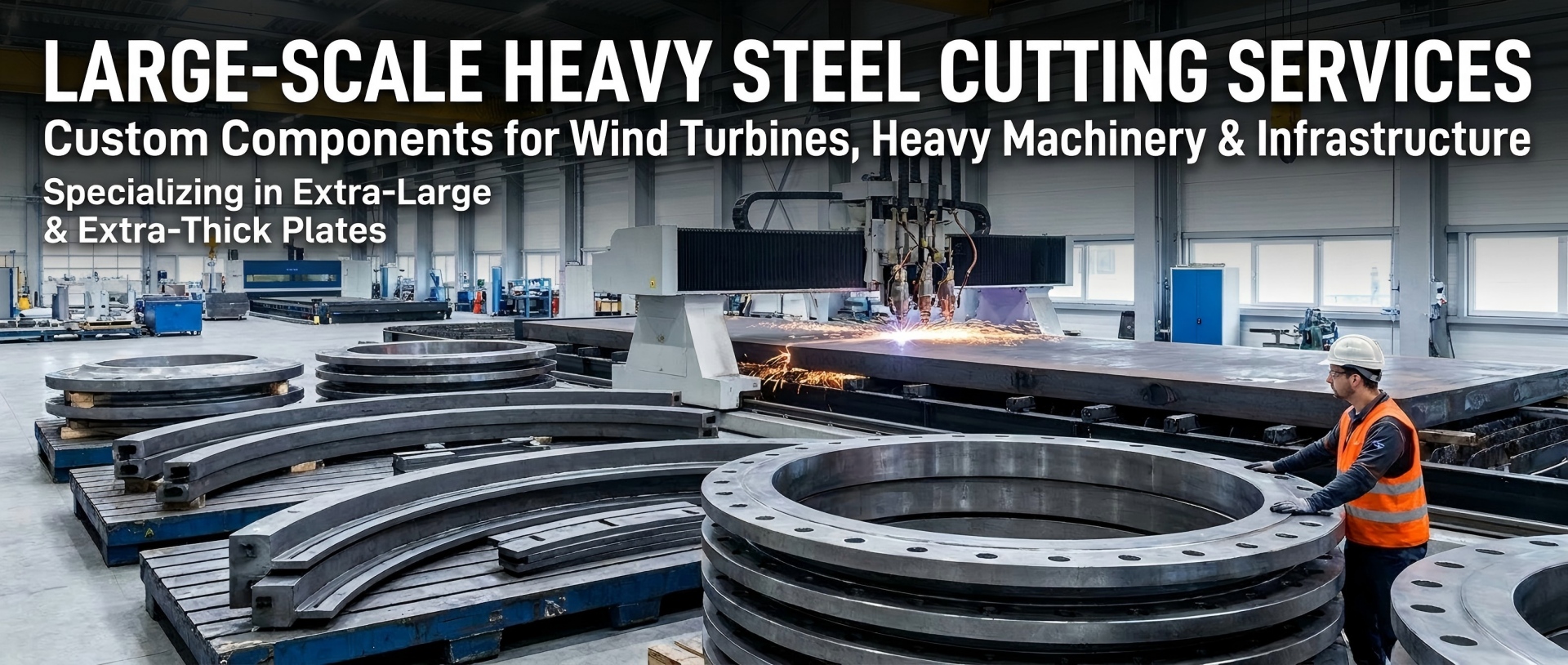
Large hot-rolled cut pieces — meaning flame-cut profiles, CNC-cut heavy plate blanks, and oversized CTL formats (typically 20 mm–300 mm thick, widths to 4,500 mm, lengths to 18,000 mm) — draw demand from:
- Wind tower sections / transition pieces (thick plate, normalized/TMCP, Z-direction tested)
- Mold & die bases / heavy machinery beds (S355NL, A36/A572, stress-relieved)
- Bridge girder segments & structural nodes
- Pressure vessel courses / shell courses (ASTM A516 Gr.60/70, EN 10028)
- Shipbuilding blocks (AH36/DH36/EH36)
These are low-volume, high-handling, high-waste products. The value-add isn’t melting — it’s cutting accuracy, edge prep, UT testing, traceability, and logistics.
In today’s market, Asian suppliers (especially China and India) can win the quote, but struggle with the delivery-compliance-insurance package for Western projects. North American and European service processors win on reliability + documentation even when their input cost is 2× higher.
5. Trade Flow Headlines — Recent News You Need to Know
| Date | Development | Impact on Cut Plate / HRC Flows |
|---|---|---|
| April 2026 | US Section 232 enforcement updated — 50% duty applied on full customs value; quota/TRQ admin tightened | Imports of commodity heavy plate into US effectively blocked except Canada/Mexico/Brazil/Korea under managed terms |
| Jan 2026 → Ongoing | EU CBAM enters formal implementation; steel importers must account embedded emissions; proposed expansion to 180 downstream steel-intensive items | Makes Chinese/Indian heavy plate less competitive in EU even if the nominal price looks cheap |
| 2025 H2 → 2026 | Anti-dumping duties on Chinese HRC/plate activated or expanded in Vietnam, Indonesia, Brazil | Redirects Chinese overflow toward MENA/Africa/Latin America; increases price competition there |
| Mar 2026 | China HRC market: capacity additions 28.3 Mt/yr under construction, margins ~zero, domestic price ¥3,270/t | Keeps China as the global swing supplier — but only where trade policy allows entry |
| July 2025 data points rolling into 2026 | India HR plate prices range-bound; mill inventories +12% YoY; imports surged to ~30,700 t in mid-July vs. ~2,469 t in June | Signals softer South Asian domestic plate market — opportunity for buyers, headache for local mills |
| Recent months | Major steel service center / processor tier consolidating in NA/EU — adding leveling, CTL, laser/plasma, edge beveling capacity | Value shifts downstream: whoever owns the processing gatecaptures margin |
6. Market Outlook — Three Scenarios (Next 6–12 Months)
Base Case (≈60% probability)
- US: HRC/plateauinthe∗∗1,050–$1,150/nt band**; cut plate pricing stays elevated; service centers keep CTL capacity busy but watch for demand softening if rates stay high.
- Europe: HRC drifts €670–€750/t; heavy plate stable but order books thin between projects.
- Asia (CN/IN): Continued pressure — overcapacity → export push → more trade cases → structural shift toward high-strength / normalized / TMCP plate differentiation.
- Net effect on large cut pieces: A processor’s market — steel is cheap somewhere, but getting it to the job site compliant and on timeis expensive.
Bull Case (≈20%) — Re-stocking + Infra Acceleration
- Simultaneous pickup in US non-res construction, EU defense/infra spend, and Middle East megaprojects → lead times blow out → cut-plate premiums spike.
Bear Case (≈20%) — Global Slowdown / China Devalues Further
- China forced to dump harder → more trade walls → domestic plate prices in India/SE Asia collapse further → global CTL spreads compress → only lowest-cost automated processors survive.
7. What This Means if You’re Making Decisions
| If you are… | The takeaway |
|---|---|
| A buyer of large cut plate (fabricator / EPC) | Stop benchmarking off “Chinese export plate FOB + freight.” Your real risk is lead time + spec compliance. Lock annual volume with a domestic / near-shore processor who can certify melt & pour, UT class, and EN/ASTM pedigree. |
| A processor / service center | This is your market — the margin is in toll processing + inventory-holding + QA/QC packaging, not in guessing steel direction. Invest in automation (laser/plasma CTL, robotic marking, digital traceability). |
| An exporter (e.g. from CN/IN) wanting to sell cut pieces to US/EU | You need a compliance architecture, not just a price. Without a solution for Section 232 origin rules or CBAM paperwork, “large cut profiles” get stuck at the border. The viable path is: value-added processing in a qualifying countryor supplying non-regulated private projects via established importers. |
| An investor / strategist | Watch two indicators: (1) US HRC spread over China (currently ~$600/t — unsustainable long-term without permanent trade walls); (2) Chinese capacity utilization / mill-loss duration (when enough mills fold, global oversupply eases — but that’s a 2027–2028 story). |
Sources & Data Points: World Steel Association demand projections (+1.8% US both 2025/26), S&P Global Platts China HRC assessments, AISI/SIMA import share tracking (~14–18%), Steel Market Update / industry pricing trackers, PMI/platform research on CTL sheet/plate processing equipment market structure, and trade policy filings on Section 232 / CBAM / AD regimes. Figures are compiled snapshots — always cross-check live against CRU, Platts, or Mysteel feeds before contracting.
If you want, tell me which specific product lane you care about — e.g. flame-cut mold/base plates (S355NL/N+AR), wind-tower roller-quenched plate, or structural CTL (A36/A572)— and I’ll narrow this into a focused procurement/sales playbook with price bands, typical mill sources by region, and the exact compliance documents you need attached to every heat.