
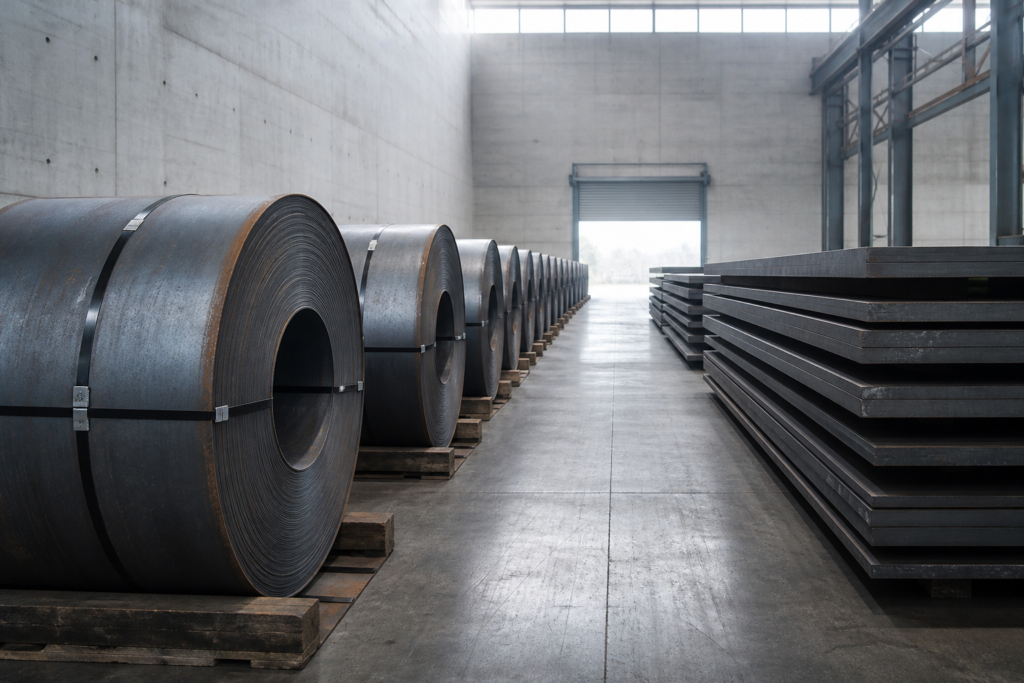
Hot Rolled Coil: EU Import Checks Tighten as Prices Fall
Two data points landed within four days of each other. World crude steel output was 142.4 million tonnes in September, down 0.2% year on year, but the EU-27 produced 10.1 million tonnes, down 5.0%, and Germany 2.6 million tonnes, down 13.0% (worldsteel, 23 October 2026). In the same week, Chinese hot rolled coil (HRC) fell to a year-to-date low on weakening demand (Kallanish, 23 October 2026).
European rolling capacity is contracting while Chinese export supply gets cheaper — on paper, a buying opportunity for EU distributors. In practice, since 1 October every shipment of covered steel entering the union must carry a document most mills never designed for the purpose.
The problem: a thinner quota and a heavier document
Regulation (EU) 2026/1384, in force since 1 July 2026, sets the duty-free volume at 18.3 million tonnes a year and applies a 50% duty above it (European Commission, 31 August 2026). Q4 2026 is the first full quarter in which both changes bite at once.
Commission Implementing Regulation (EU) 2026/1963 of 28 August 2026 makes the second half concrete. From 1 October 2026 importers must declare the country of melt and pour, supported primarily by a mill test certificate stating that country and the heat number. The country is declared through TARIC document codes, and failure to declare it with verifiable evidence leads to rejection of the import (Articles 1 and 2).
There is a one-year bridge. Until 30 September 2027, invoices, delivery notes, quality certificates, contract clauses, long-term supplier declarations or export customs documents can stand alone as evidence if they carry both the melt-and-pour country and the heat number. From 1 October 2027 they are accepted only as complements to the certificate (Article 1(3); Irish Revenue guidance, September 2026).
Why the heat number is a purchasing problem, not a paperwork problem
The Commission is explicit that the mill test certificate “is neither a harmonised document nor specifically designed to demonstrate the country of melt and pour” (recital 9). Many certificates in circulation list grade and chemistry but not the two fields customs now asks for. Evidence other than the certificate triggers documentary checks that can delay quota access (recital 9).
For a steel coil supplier the practical consequence is that the document set is assembled before the proforma, not after the vessel sails. The German figure explains why EU buyers cannot simply wait for domestic mills to close the gap: at 13.0% below September 2025, German output is not covering the shortfall.
What to buy, and to which specification
Compliance does not change what a press shop needs. It changes how precisely the requirement is written down.
Hot rolled and cold rolled coil
For structures, tube making and general fabrication, hot rolled steel sheet and coil in SS400, Q235B or S235JR is commonly supplied pickled and oiled from 1.8 mm to 25 mm, in widths up to 1,500 mm, subject to mill availability. For appliance, cabinet, furniture and door-frame work, cold rolled steel coil in DC01, DC03, DC04 or SPCC is commonly supplied at 0.3–3.0 mm; specify surface quality, oiling and thickness tolerance in writing, because those three decide scrap rate. Full data sits on the cold rolled steel coil page.
Coated coil
Where corrosion resistance matters, galvanized steel coil in DX51D+Z at 120–275 g/m² zinc and prepainted steel coil for visible panels follow the same discipline: name the zinc mass, the paint system and the heat number on the purchase order, not just on the packing list.
Plate and cut parts
Medium and heavy steel plate in S235JR and S355JR is commonly supplied from 8 mm to 150 mm, with Z15/Z25/Z35 through-thickness options where the design requires them. Here traceability breaks most often: once plate is cut, the heat number must follow the part. Steel plate cutting parts supplied with a heat-number map per nest solve that, and remove the double handling that costs most on thick sections.
Electrical steel
Transformer and motor laminations sit outside the construction cycle but not outside the regime. CRGO electrical steel for wound cores is commonly supplied at 0.23–0.35 mm in M3–M6 equivalent grades, subject to mill allocation; the grade, lamination factor and heat number travel on one certificate. Product detail sits on the CRGO electrical steel page.
A supplier’s view: quote the certificate, not the promise
Trade defence is widening too. Korea’s Trade Commission is seeking anti-dumping duties of up to 33.67% on Chinese galvanised cold-rolled products (Mysteel, 26 October 2026): a quote that works for Rotterdam may not work for Busan, so a China steel supplier prices the destination, not the product.
Four habits separate a clean Q1 2027 delivery from an argument.
- Put the melt-and-pour country on the quotation. Ask for the heat number and a certificate sample before the proforma. If the mill certificate omits either field, arrange complementary evidence now, while it is still admissible alone.
- Run two landed costs. Price every enquiry inside quota and at the 50% rate. A steel coil price that only works in-quota is not a price, it is a bet on allocation.
- Keep the heat number through processing. Slitting, cut-to-length and profile cutting all break the link between coil and certificate unless the sub-lot is recorded at each step.
- Do not bet on quota timing. Ship against a confirmed balance, not an assumption about next quarter.
We trade cold rolled, hot rolled, galvanized and prepainted coil, low-alloy coil, plate, cut parts and electrical steel from Chinese mills including Baosteel, Anshan and Wuhan, for steel structures, switchgear, power distribution, automotive parts, appliances and steel furniture. Grades and size ranges above are commonly supplied and subject to mill availability and the final mill test certificate.
Next step
Building a Q1 2027 requirement around the new regime? Send grade, gauge, quantity and destination port; we will reply with a specification-matched offer, the document set your broker will ask for, and an indicative landed cost inside and outside quota. Start with the product range, read about our company, or contact us.
Sources
- European Commission, 31 August 2026 — Commission sets type of evidence to prove country of melt and pour
- Commission Implementing Regulation (EU) 2026/1963 of 28 August 2026 (OJ L, 31.8.2026)
- World Steel Association, 23 October 2026 — September 2026 crude steel production
- Kallanish, 23 October 2026 — Chinese HRC hits year-to-date low on weakening demand
- Mysteel, 26 October 2026 — Korea’s Trade Commission seeks ADs on Chinese galv CR up to 33.67%
- Air Freight News, 22 September 2026 — EU steel imports: melt and pour evidence requirements (Irish Revenue guidance)