
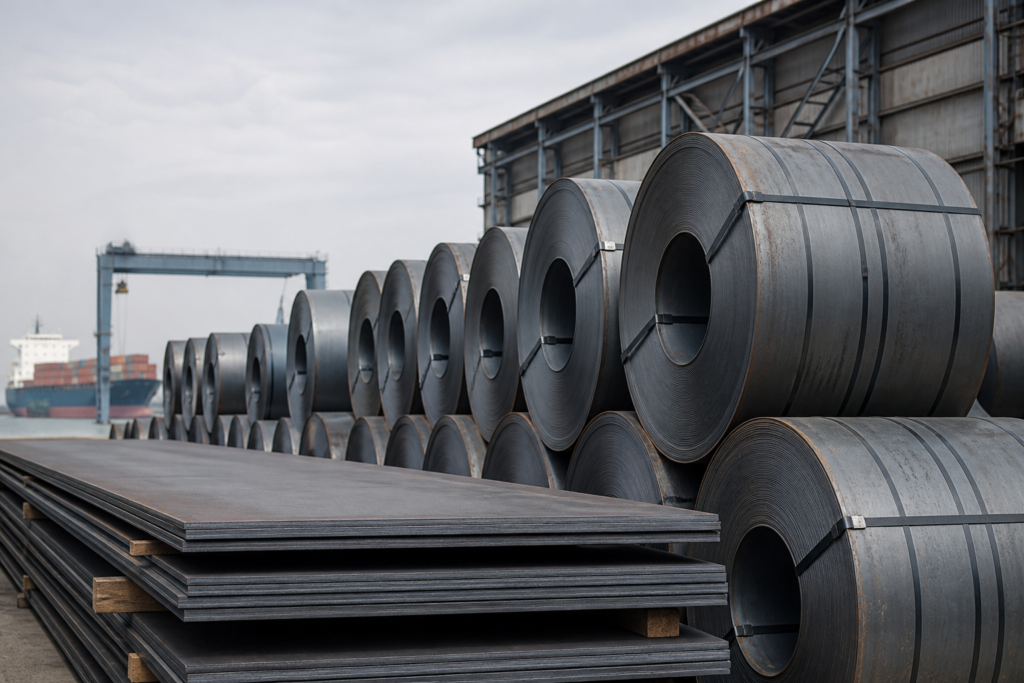
How to Verify a Steel Supplier in China: A 7-Point Supply Chain Checklist
In short: Verifying a Chinese steel supplier means checking seven things in order — which mills actually stand behind them, how wide their product range is, whether they process steel in-house, which third-party certifications they hold, what long-term customers they can prove, how they handle logistics, and whether quality is traceable back to the mother plate.
Why the supply chain matters more than the price
A steel quotation is a claim about the future. The number tells you what a supplier hopes to charge; the supply chain tells you whether the plate will actually arrive, on spec, on time, and traceable if something fails in service.
Buyers who verify price alone tend to discover the difference later — when a mill allocation shifts, when a substitute grade appears, or when a part cannot be traced back to a heat number. The checklist below is ordered the way the risk actually accumulates.
Check 1 — Which mills actually stand behind the supplier?
Ask for named mills, not for “reliable domestic sources”. A serious supplier will name the mills and the product types each one covers.
The supply chain behind Nanjing Tiange Metal Trading Co., Ltd. covers five named mills:
| Mill | Products supplied |
|---|---|
| Baosteel | Cold rolled coils |
| Maanshan Iron and Steel | Cold rolled coils, galvanized aluminium-zinc plated coils |
| Panzhihua Iron and Steel | Cold rolled coils |
| Angang | Hot rolled coils, low-alloy coils, medium-thick plate, cutting parts |
| Wugang | Hot rolled coils, low-alloy coils, medium-thick plate, cutting parts |
Five sources matter commercially: if one mill’s allocation tightens, or a grade is not available on one line, the order can move rather than wait.
Check 2 — Can they cover the full product and size range?
A narrow range forces you to manage more suppliers. Ask for the envelope: categories, grades, thickness, width, length and maximum single-piece weight.
Through its mill partners, the range behind us is:
- 12 product category series
- More than 300 steel grades
- Thickness: 6-650 mm (some lines to 700 mm)
- Width: 1,150-4,020 mm
- Length: 3,000-27,000 mm
- Maximum single-piece plate weight: 38 t (up to 60 t rolled from taper ingot)
If a supplier cannot state these numbers without checking, they are not buying directly.
Check 3 — Do they have in-house processing, or are they pure traders?
This is the single biggest difference between suppliers who look identical on paper.
A pure trader buys and resells. A supplier with processing carries the risk of dimensional error, edge quality, flatness and packing — and can be held accountable for the finished part, not just the plate. The processing capability behind our supply chain includes flame, plasma and laser cutting, bending, beveling, machining and sawing, plus annual plate cutting capacity above 120,000 tonnes.
For buyers, in-house processing means one contract, one delivery, and one party responsible when a part does not match the drawing.
Check 4 — Which third-party standards and certifications do they hold?
Certification is how a supplier proves that a claim about steel quality is not just an internal opinion. Ask specifically which standards, and for which product lines.
Standards covered across the supply chain include GB, ASTM / ASME, JIS, DIN, EN, ISO, CCS, and classification society approvals from ABS, DNV and GL. Specific certifications relevant to demanding applications include:
- Nuclear island class plate (16MND5, 18MND5, SA533) to French and American quality assurance systems, max thickness 178 mm, max single piece 37 t
- 215 mm offshore gear rack plate, certified by ABS, DNV and GL — the only plate of this thickness for deep-sea platform gear racks to pass classification society certification in China
- 300 mm Z-direction hydropower plate, certified by the State Council Three Gorges Project Construction Committee as equivalent to foreign products and suitable for 700 MW class turbine generator units
Check 5 — What long-term customer relationships can they prove?
Repeat business over many years is harder to fake than a catalogue. Ask how long the longest customer relationship has run, and what the supplier does for that customer.
Nanjing Tiange Metal Trading Co., Ltd. was established in March 2016 and has been the exclusive steel supplier to an A-share listed precision air-conditioning manufacturer in Nanjing for 8 years. Its customer base also covers automotive and motorcycle parts manufacturers supplying major automakers, high and low voltage distribution cabinet producers serving provincial grid companies, screen cabinet makers for the power sector, and air-conditioning component suppliers.
References matter because they prove the supplier has survived the moment when supply gets difficult — which is the moment you are actually paying to avoid.
Check 6 — How do they handle logistics and delivery?
Steel is heavy, and the last kilometre is where schedules slip. Ask whether logistics is in-house, whether delivery goes to the factory or to a port, and who is accountable for damage in transit.
A supplier with mature supporting processing equipment and logistics transport can guarantee the integrity and safety of the customer’s supply chain — the plate arrives cut, packed and ready for the line rather than waiting for a third-party haulier to be arranged.
Check 7 — Is quality traceable back to the mother plate?
Ask one question: “If I need to trace a delivered part back to the heat, can you do it?” A supplier with an ERP and EMS system codes each cut part and links it to the original mother plate. A supplier without one has to search paper records.
Traceability is not a paperwork preference. In pressure vessel, energy and structural applications subject to third-party inspection, it is often the difference between accepting and rejecting a delivery.
Red flags: when to walk away
| Signal | Why it is a problem |
|---|---|
| Cannot name the mills it buys from | Suggests brokered or spot sourcing, not a stable channel |
| Cannot quote thickness, width or length limits | Does not buy directly from a mill |
| No in-house cutting, forming or packing | Every dimensional problem becomes a dispute |
| Vague on standards (“all certificates available”) | No product-specific certification |
| No repeat customer willing to be described | No evidence of surviving a hard market |
| No coding or traceability system | Cannot support inspection or claims |
| Accepts any lead time instantly | Either no mill allocation, or a commitment it cannot keep |
Frequently asked questions
How do I verify a steel supplier in China? Check seven points in order: named mills, product and size range, in-house processing, third-party certification, long-term customer references, logistics handling, and traceability back to the mother plate.
What is mill-direct sourcing in steel? Mill-direct sourcing means the supplier buys from named steel mills under a stable channel rather than from spot traders, so grade, origin and availability are predictable.
Why does in-house processing matter when buying cut parts? It assigns dimensional and edge quality to the same supplier you bought the plate from, giving you one contract, one delivery and one accountable party.
Which certifications should a steel supplier hold? It depends on the application — GB, ASTM/ASME, JIS, DIN, EN and ISO cover most general supply, while CCS and ABS, DNV or GL classifications are required for shipbuilding and offshore components.
How long should a supplier’s customer relationships be? Look for relationships measured in years rather than transactions. Nanjing Tiange has supplied its longest-standing customer exclusively for 8 years.
Contact
Nanjing Tiange Metal Trading Co., Ltd. Mill-direct steel sourcing, processing and logistics Email: postmaster@tigosteel.com Phone / WhatsApp / Telegram: +86 138 1389 7227 Web: www.tigosteel.com Nanjing, Jiangsu, China