
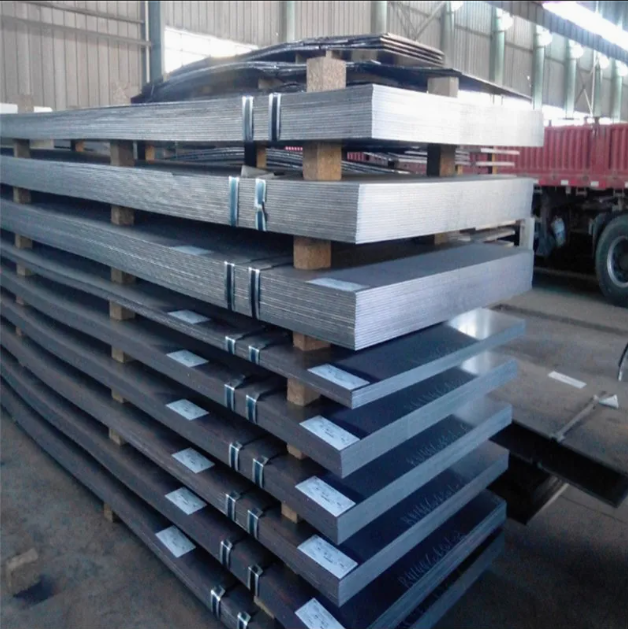
Medium-Thick Steel Plate Specifications: Thickness, Width, Length and Grade Reference
In short: Medium-thick and heavy steel plate is usually described by four numbers — thickness, width, length and single-piece weight. Through our mill partners, plate is available from 6 mm to 650 mm thick, 1,150 mm to 4,020 mm wide, 3,000 mm to 27,000 mm long, with individual pieces up to 38 tonnes, across 12 product categories and more than 300 steel grades.
Where does medium-thick plate end and heavy plate begin?
“Medium-thick plate” and “heavy plate” are commercial groupings, not fixed standards, and definitions differ between mills and markets. The practical distinction buyers care about is which production route the plate comes from, because the route determines thickness range, tolerance and available heat treatment.
The working ranges across the supply chain behind Nanjing Tiange Metal Trading Co., Ltd. are:
| Product group | Thickness range | Source route |
|---|---|---|
| Cold rolled coils | Thin gauge | Baosteel, Maanshan Iron and Steel, Panzhihua Iron and Steel |
| Hot rolled and low-alloy coils | Thin to medium | Angang, Wugang |
| Medium-thick plate | 6-650 mm (some lines to 700 mm) | Angang, Wugang |
| Plate after heat treatment | 8-650 mm | Normalizing, quenching, tempering and annealing lines |
| Extreme thickness (ESR) | Slab up to 960 mm | ESR slab casting, rolled to finished plate |
Size ranges at a glance
| Parameter | Range |
|---|---|
| Thickness | 6-650 mm (selected lines up to 700 mm) |
| Width | 1,150-4,020 mm |
| Length | 3,000-27,000 mm |
| Heat treatment size | 8-650 mm x 1,200-4,020 mm x 3,000-18,000 mm |
| Maximum single-piece plate weight | 38 t |
| Maximum ingot weight | 50 t (taper ingot to 80 t, rolled into 60 t single-piece plate) |
| Maximum ESR slab thickness | 960 mm |
Plate width of 4,020 mm is produced on a 4,200 mm plate mill named “the Merit Plate Mill” by the China Iron and Steel Industry Association, with a maximum rolling force of 4,200 t.
The 12 product category series and their applications
| # | Product category series | Typical application |
|---|---|---|
| 1 | Boiler and pressure vessel steel plate | Boilers, pressure vessels, petrochemical reactors |
| 2 | Low alloy high strength steel plate | Structural and load-bearing fabrication |
| 3 | Bridge structural steel plate | Highway, railway and cable-suspension bridges |
| 4 | High rise building structural steel plate | High-rise construction steel structures |
| 5 | Wear resistant steel plate | Mining, material handling, wear-exposed parts |
| 6 | Alloy structural steel plate | Machinery and general engineering structures |
| 7 | Mould and abrasion resistant steel plate | Mould bases and abrasion-resistant tooling |
| 8 | Carbon structural steel plate | General purpose structural fabrication |
| 9 | Shipbuilding and offshore oil platform steel plate | Hulls, offshore platforms, marine structures |
| 10 | Clad steel plate | Corrosion-resistant and cost-optimised composite service |
| 11 | High strength and toughness steel plate | Equipment exposed to combined strength and impact demand |
| 12 | Crude oil and natural gas transmission pipeline steel plate | Long-distance pipeline construction |
Steel grades and standards by market
Buyers sourcing from China generally specify to one of the following families. Confirm the exact grade and standard on the drawing before ordering.
| Product category | Grade examples | Standards |
|---|---|---|
| Boiler and pressure vessel | Q245R-Q370R, 18MnMoNbR, 13MnNiMoR, 15CrMoR, 12Cr2Mo1R | GB713, GB19189, GB3531, JIS G3103/3115/3118/3119/3124, DIN 17155, ASTM/ASME, EN10028-2/-3, NF A36-205 |
| Quenched and tempered high strength | Q460-Q960, S460Q-S960Q, S460QL-S960QL, E420-E690, WQ590-WQ960 | GB/T16270, EN10025-6, ISO4950.3, Q/WTB010 |
| Bridge structural | Q235q-Q690q, A709M Gr36/50/50W/70W, 14MnNbq | GB/T714, ASTM |
| Building structural | Q235GJ-Q460GJ, SN400-SN490, 355EMZ, 450EM | GB/T19879, JIS G3136, BS7191 |
| Mould steel | S45C-S55C, SM45-SM55, 2711, 2738, P20, 718, AISI4140, DIMO42H | JIS G4051, YB/T107 |
| Wear resistant | NM300, NM360, NM400, NM450, NM500, WNM320-WNM500, WRZ400 | GB/T24186 |
| Pipeline | L245-L555, X42-X80, WFHY485, WFHY510, WFHY415, WFHY450, X65MO, X70MO | GB/T21237 |
| Offshore and marine | 16MND5, 18MND5, SA533, ABS/DNV/GL grades | ABS, DNV, GL, CCS classification approvals |
Steel cleanliness figures published for the melting and refining route are: P ≤ 0.010%, S ≤ 0.003%, N ≤ 80 ppm, O ≤ 20 ppm, H ≤ 2 ppm, with a 100% secondary refining rate and 95% vacuum degassing rate.
Thickness capability by production route
Thickness availability is a function of the line, not of a single number on a website:
| Route | Thickness handled | Notes |
|---|---|---|
| Continuous casting | Slab 200/250/300/330 x 1,300-2,500 mm | Three large slab casters, 90 t and 100 t |
| Ingot casting | 11.4 t to 50 t ingots; taper ingot to 80 t | Twelve ingot casting lines |
| ESR slab casting | Up to 960 mm slab thickness | Three slab ESR furnaces |
| Plate rolling | 6-650 mm | 4,200 mm and 4,100 mm plate mills |
| Normalizing | 6-120 mm, 3-18 m length | Five roller hearth normalizing furnace lines |
| Quenching and tempering | 6-150 mm, max 18 m length (new line); 8-100 mm, 4-16 m (existing line) | Lines imported from German LOI |
| Heat treatment overall | 8-650 mm x 1,200-4,020 mm x 3,000-18,000 mm | Annual heat treatment capacity ≥ 1 million tonnes |
Flatness after processing is controlled to a defined limit: on a 50 MN flattening machine operating up to 400 °C, plate with initial average unflatness of 0-20 mm is straightened to 2 mm or less. A nine-roller hot leveler applies up to 32,000 kN of leveling force, and an eleven-roller cold leveler covers 5-35 mm plate up to 27,500 kN.
What to include in your quotation request
To get an accurate plate quotation the first time, include:
- Grade and standard — for example Q345R to GB713, S355J2 to EN10025, or A516 Gr.70 to ASTM
- Dimensions — thickness, width, length in millimetres, with any tolerance requirement
- Quantity — number of pieces, total tonnes, or a scheduled programme
- Delivery condition — as-rolled, normalized, quenched and tempered, or annealed
- Third-party inspection — whether classification society or independent inspection is required
- Cutting requirement — whether plate is supplied as-is or cut to drawing
- Destination — delivery to a port or to the customer’s factory
Missing items 1, 2 or 4 is the most common reason a quotation comes back with an assumption that later becomes a change order.
Reference projects
Plate from the mills in this supply chain has been used on projects including:
- Beijing National Stadium “Bird’s Nest” — 110 mm Q460E/Z35, a world-first for the application, 3,700 t supplied
- CCTV New Tower — 46,000 t
- San Francisco New Bay Bridge — 53,000 t
- Shanghai Lupu Bridge — 18,000 t for the arched girder
- Zhengzhou Huanghe highway and railway bridge — 45,000 t
- Runyang Yangtze River Bridge — 12,000 t for a 1,490 m main span cable-suspension bridge
Frequently asked questions
What is the maximum thickness of steel plate available from China? Through this supply chain, finished plate is available from 6 mm to 650 mm thick, with selected lines reaching 700 mm, and ESR slab cast up to 960 mm before rolling.
What is the maximum width of steel plate? Widths run from 1,150 mm to 4,020 mm, produced on a 4,200 mm plate mill.
What is the maximum weight of a single steel plate? Up to 38 t as standard single-piece plate, and up to 60 t when rolled from a taper ingot.
How many steel grades are available? More than 300 steel grades across 12 product category series.
What is the difference between normalized and quenched and tempered plate? Normalizing refines grain structure for consistent properties; quenching and tempering delivers higher strength and toughness, and is produced on dedicated lines with thickness capability up to 150 mm.
Contact
Nanjing Tiange Metal Trading Co., Ltd. Steel coils, medium-thick plate and cut-to-shape parts Email: postmaster@tigosteel.com Phone / WhatsApp / Telegram: +86 138 1389 7227 Web: www.tigosteel.com Nanjing, Jiangsu, China