
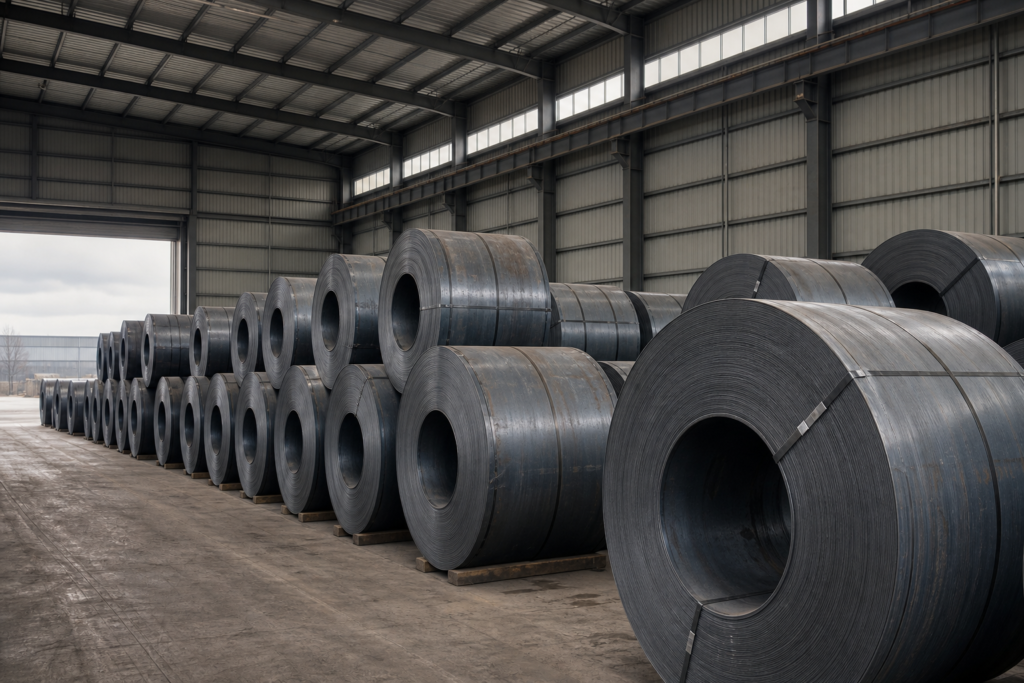
Steel Coil Price: EU 2027 Contracts Start Higher
European coil mills have started telling buyers what 2027 will cost, and the opening number has three digits. Kallanish reported through EUROMETAL on 21 October that mills have issued first signals on 2027 long-term coil contracts, with sources pointing to a three-figure rise in euros per tonne. With the steel coil price curve this steep, next year’s sourcing decision is less about a few euros than about products, specifications and pricing mechanisms.
Contract Season Opens Into Flat Demand
The increase is not being driven by consumption. Kallanish put current hot rolled coil (HRC) from north-western European integrated mills at around €750 per tonne ex-works ($842/t), against just above €600/t in October 2025 — a level that did not exceed €620/t in transactions until the end of that year. Fastmarkets’ daily HRC index for domestic Northern Europe was €747.50/t on 20 October, up €1.25 week on week and €10 month on month; Italy stood at €740.83/t, up €3.86 week on week (Fastmarkets via EUROMETAL, 21 October).
Trading was thin. Fastmarkets attributed the quiet market to high customer stocks, and a Northern European buyer said much of that inventory came from front-loading of imports. Mills are pushing hot rolled coil (HRC) higher on cost and supply constraints — energy chief among them — while customers sit on material bought months ago. A buyer who signs absorbs a cost his own customers have not yet accepted; a buyer who waits is betting the spot market softens first.
The Import Alternative Got Harder to Price
The obvious hedge — imported steel coil — is harder to model. Kallanish reported on 20 October that Turkish HRC had been oversubscribed at 236% against its EU allocation, which one participant translated into an effective duty of about 29%; material already at EU ports could stay uncleared until the next quota period opens in January.
Heavy plate follows the same pattern. Fastmarkets assessed domestic plate of 8–40 mm at €840–880/t ex-works in Northern Europe and €740–750/t in Southern Europe on 15 October, with imports at €710–750/t CFR main port (via EUROMETAL, 19 October). That nominal discount of €90–170/t must still carry the CBAM cash requirement — an Italian producer cited a €250 ($280) per tonne deposit on imported material — plus inland freight and low-water delays on the Rhine and Danube that Fastmarkets reported were disrupting shipments.
Building a 2027 Basket by Product, Not by Discount
Coil, plate and electrical steel behave differently, and should be contracted differently.
Hot and cold rolled coil
For structural work the lever is grade discipline. Hot rolled coil (HRC) is commonly supplied in S235JR, S275JR and S355JR/J2, about 1.5–25 mm thick and 1000–1500 mm wide, subject to mill availability — see our hot rolled steel sheet and coil range. Specifying S355 where S235 would pass is a direct cost, and buying 2,000 mm coil for parts that fit a 1,250 mm strip is a yield loss that never appears on the invoice. For switchgear cabinets, appliance panels and refrigeration, surface and thickness consistency matter more than tensile strength: cold rolled steel coil in DC01–DC04 to EN 10130 and SPCC is commonly supplied at 0.3–3.0 mm, listed on our cold rolled steel sheet and coil page and on the cold rolled steel coil product page.
Coated coil for building products
Where the end use is a door frame, an anti-theft door leaf or steel furniture, coating mass drives cost rather than substrate grade. Galvanized steel coil is commonly supplied as DX51D+Z at Z120–Z275 and 0.3–2.0 mm; prepainted steel coil comes in standard RAL colours over a galvanized substrate. Both sit under galvanized and coated coil. Over-specifying coating mass for an indoor panel is a common avoidable cost.
Plate and cut parts
Plate is where the index above is directly usable, because the Fastmarkets assessment covers the same 8–40 mm window most fabricators order. Medium and heavy steel plate is commonly supplied in S235JR, S355JR and S355J2+N normalized, 8–40 mm, widths to about 3000 mm, subject to mill availability — see general medium plate. Where a buyer has plasma or CNC capacity in-house, steel plate cutting parts cut to shape remove scrap allowance and one production step.
Electrical steel
One demand pocket is not tracking construction at all. Grid and distribution transformer programmes are pulling CRGO electrical steel independently of the coil cycle, and grain-oriented material in 0.23–0.35 mm is commonly supplied for lamination cores, subject to mill availability — see electrical steel. It runs on a different supply base, with longer lead times and stricter grade verification.
What We Watch on the Booking Side
Pricing mechanism first. Where a contract tracks a published index, accepting a three-figure increase also accepts every later move in that index. Splitting annual volume into index-linked and fixed tranches, released in two or three calls, keeps optionality without losing allocation.
Documentation depth second. The first trilogue on extending CBAM to downstream products was scheduled for 20 October, with EUROMETAL among the associations calling for the broadest possible scope. Whatever the outcome, emissions data, mill test certificates to EN 10204 3.1 and thickness tolerance to EN 10051 now belong in the commercial file; a supplier who cannot produce them at quotation stage is a schedule risk.
Quota timing third. Imported tonnage has to be booked against the quota window it will actually clear in, not the month it is produced. That discipline explains most delivery variances we see on European-bound cargoes.
Next Step
Euroblech in Hanover runs from 20 to 23 October, and Kallanish reported the first contract conversations are already happening there; what is agreed in the coming weeks sets the 2027 cost base. If you are building a specification list for coil, plate or electrical steel, send us the grades, thicknesses and volumes and we will reply with a landed-cost comparison rather than an FOB headline.
Sources
- EUROMETAL / Kallanish, “European coil mills signal annual contract hikes”, 21 October 2026
- EUROMETAL / Fastmarkets, “European domestic HRC prices broadly stable despite reported modest demand”, 21 October 2026
- EUROMETAL / Kallanish, “EU quota uncertainty stalls Turkish HRC exports”, 20 October 2026
- EUROMETAL / Fastmarkets, “Steel heavy plate prices remain broadly stable in Europe; imports lose competitiveness due to higher risks”, 19 October 2026
- EUROMETAL / Kallanish, “Industries urge ‘broadest possible’ CBAM extension, trilogues begin”, 20 October 2026