
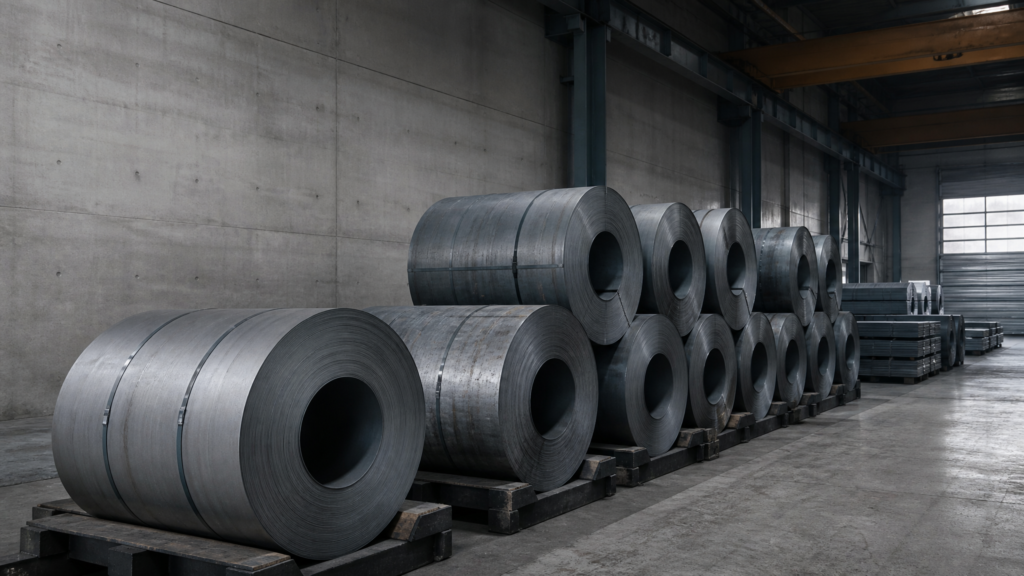
Steel Coil Price Floor Is Slipping: What Buyers Should Do
The cost side of the Chinese flat steel market turned in the third week of October, and it did so quietly. SMM’s sheets and plates review on 19 October put the most-traded HRC contract at 3,236 yuan per tonne, down 0.09% intraday, with no new hot-rolling maintenance this week and idled lines gradually resuming. SMM expects supply to rebound month on month, and records that a sharper decline in coking coal and coke has “weakened HRC cost support at the margin.”
That matters more than the tick. A steel coil price no longer pushed by raw materials drifts, discounts at the mill gate, and rewards buyers who can wait — but only while freight and trade timing hold still. This month they do not.
CISA reported that member mills produced 1.939 million tonnes of crude steel per day in 1–10 October, up 3.1% on 21–30 September, while finished steel inventories reached 16.97 million tonnes on 10 October, 8.4% higher than 30 September (SteelOrbis, 16 October). Output is outrunning absorption: destocking pressure, not scarcity. Yet SMM put Chinese HRC export transactions at $491–495 per tonne on 19 October, up $1 week on week. Mills are holding offers, not chasing volume — the floor is administrative as much as economic.
Europe is being held up by policy, not demand
Kallanish reported on 15 October that Italian heavy plate is rising in new contracts: S275 at €780 per tonne base ex-works or delivered, S355 at a premium of about €20, with mills considering €800. Lead times stretch to end-November. A mill source attributed the balance to the trade regime: “The new quotas system has wiped off 1 million tonnes of imports per year.”
That frame is verifiable. The European Commission’s factsheet caps duty-free steel entry at 18.3 million tonnes a year, reserves 9.15 million tonnes for FTA partners, and applies a 50% duty once a partner’s quota is exhausted. A supply ceiling in law is why European medium and heavy steel plate holds €780 per tonne while Chinese coil costs soften.
Demand is not doing the work. Eurostat data reported by SteelOrbis showed euro area industrial production down 0.5% month on month in August, 1.1% below August 2025. worldsteel’s Short Range Outlook, published 12 October, cut 2026 global demand growth to flat at 1,722 million tonnes, lowered 2027 to 1.7%, and expects Chinese demand to contract 2%; EU apparent use falls 0.3% this year before recovering 3.1% in 2027. European prices run on quota rent, Chinese prices on a softening cost curve, and neither on consumption.
What to specify, grade by grade
The question is which grades absorb a policy-driven price and which should be bought on cost.
Hot rolled coil (HRC) and pickled coil
Commodity hot rolled coil (HRC) transmits the Chinese cost story fastest. S235JR and S275JR to EN 10025-2 in 1.5–20 mm, widths 1000–1500 mm, are the most price-transparent items in the basket; pickled SPHC in 1.8–6.0 mm removes scale for cold forming. Range: hot rolled steel sheet and coil.
Cold rolled steel coil
Cold rolled steel coil is where thickness tolerance, not headline price, decides real cost. DC01 to DC05 under EN 10130 and SPCC under JIS G3141, in 0.3–3.0 mm, cover appliance panels, switchgear enclosures, steel furniture and door frames — where a 0.02 mm drift becomes press-shop scrap. Fix tolerance class and weight basis before comparing offers: cold rolled steel sheet and coil.
Galvanized and prepainted coil
Galvanized steel coil to DX51D+Z under EN 10346 with Z120–Z275 coating covers enclosures, cable trays and light framing; prepainted steel coil adds a coil-coated finish where batch-to-batch colour consistency matters more than substrate saving. Coating mass drives service life: galvanized and coated products.
Medium and heavy plate
S275JR and S355JR to EN 10025-2 in 6–200 mm, with Z35 through-thickness quality where welded joints demand it, cover structural fabrication and equipment bases; NM360–NM600 wear plate covers abrasive duty — see the wear resistant plate page and general and medium plate range.
CRGO electrical steel and cut parts
CRGO electrical steel sits almost outside this cycle. Grain-oriented grades at 0.23–0.35 mm for transformer cores are bought on core loss, not the coil index, and European capacity is still being built: ArcelorMittal’s €500 million Mardyck expansion has run three lines since March, with first tests on its annealing-pickling line and reversing mill due in spring 2027 (SteelOrbis, 15 October). See the CRGO electrical steel page and electrical steel category. For heavy sections cut to drawing, steel plate cutting parts avoid in-house burning.
Our view from the loading bay
As a China steel supplier, we see three things a price chart cannot show.
Offer validity is shorter than the market’s memory. Ex-China indications are held for days, not weeks; a $5 per tonne concession is easily erased by an $8–10 freight move or a closed booking slot. Chasing the last dollar is usually worse than fixing a workable price with a confirmed sailing window.
Documentation is part of the specification. Mill test certificates to EN 10204 3.1 with heat-number traceability, thickness tolerance to EN 10051 and an explicit weight basis are what let a buyer defend a landed cost internally — and, as carbon reporting widens, answer questions about where the steel came from. A steel plate supplier who cannot produce that paper is selling a discount the buyer pays for later.
Split the basket, not the bet. Cover urgent plate from a regional source where lead times already run to end-November; book scheduled cold rolled steel coil and galvanized steel coil tonnage from China against fixed specifications; and plan CRGO earlier, separately, because its constraint is grade availability, not price. Grades, thickness ranges and mill allocation are commonly supplied subject to mill availability — so put them in the enquiry, not the assumption.
If you are re-planning Q4 tonnage, send us your specification list and we will tell you what is realistic for your sailing window.
Sources
- SMM — Sheets & Plates Daily Review, 19 October 2026
- SMM Steel — ex-China sheets and plates export prices, 19 October 2026
- SteelOrbis — CISA mills’ daily crude steel output up 3.1% in early October 2026, stocks up 8.4%, 16 October 2026
- SteelOrbis / Eurostat — Euro area industrial output down 0.5% in August 2026 from July, 16 October 2026
- EUROMETAL / Platts — Worldsteel cuts global steel demand forecast on China slowdown, 16 October 2026
- EUROMETAL / Kallanish — Italian plate prices increase, lead times lengthen, 15 October 2026
- European Commission — Factsheet: EU steel measure
- SteelOrbis — ArcelorMittal advances Dunkirk EAF and Mardyck electrical steel projects, 15 October 2026