
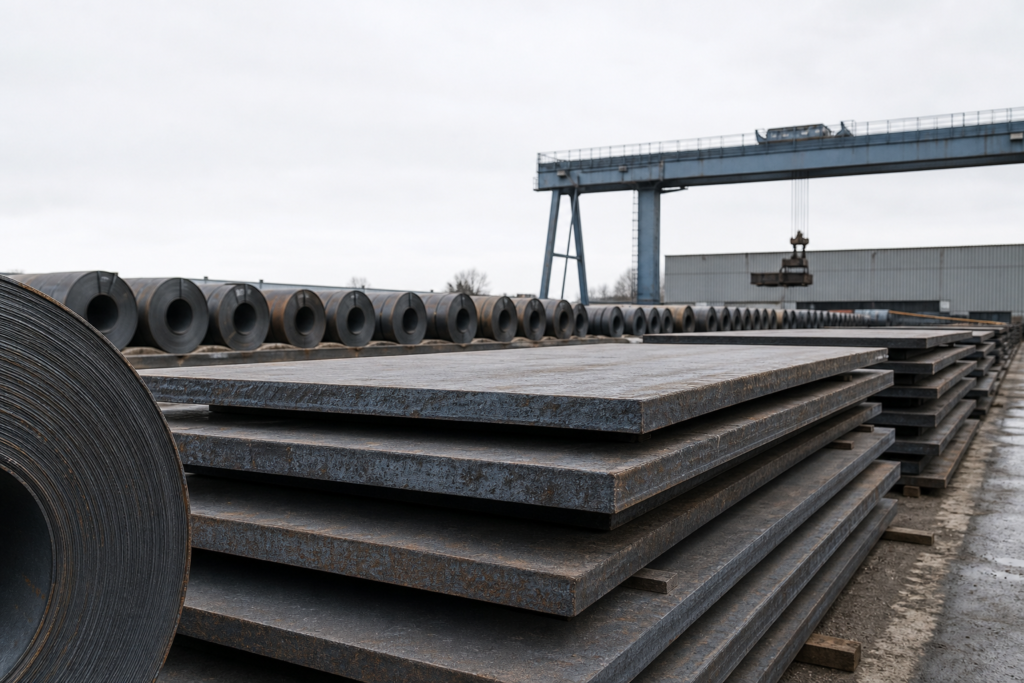
Steel Coil Supplier Insight: EU Imports Drop by Half
Europe’s flat steel market has a supply problem that the headline spot price does not show. EU hot rolled coil imports ran at just under 800,000 t across July and August — roughly 400,000 t a month — against a January–June monthly average close to 780,000 t, Argus Media reported on 19 October. In the same week, German crude steel output for September came in at 2.6 Mt, down 13.0% year on year, according to worldsteel. Neither figure is a demand story; both are volume, and together they change what a steel coil supplier can offer for the first half of 2027.
Two Numbers Behind the 2027 Contract Offers
The quota cut volume, not only price
The EU’s steel regulation caps duty-free imports at 18.3 Mt a year and applies a 50% duty above a partner’s allocated quota, according to the European Commission’s factsheet. Argus’s arrival data shows the effect: imports peaked at 2.75 Mt in April–June, then fell to just under 800,000 t over July and August as the tighter regime applied.
Mills have priced that scarcity. At Euroblech in Hanover, one EU producer was reported offering €860/t for hot rolled coil (HRC) and €960/t for hot-dipped galvanised coil to automotive OEMs — about €100/t above spot — while the Argus Northwest EU HRC index reached €739.50/t ex-works on 16 October, from €626/t on 2 January. Kallanish, reporting via EUROMETAL, put the offers at €840–860/t HRC and €940–960/t HDG. “Material will be missing from the market, but we have to see what demand will be like,” one mill source told Argus; a tier-1 automotive supplier expected buyers to settle nearer €70/t.
Weak demand, tight tonnage
The gap is not a demand signal. Weak consumption is why European inventories are high and why spot steel coil price levels held a €740–750/t ex-works band in Northern Europe and Italy on 20 October, per GMK Center. The premium is the price of secured tonnage and a delivery date that holds.
Germany’s blast furnaces stepped back
German crude steel fell 13% year on year to 2.63 Mt in September, with the blast furnace and basic oxygen furnace route down 20.2% to 1.7 Mt while electric arc furnace output rose 4.3% to 929,000 t, per WV Stahl data reported by S&P Global via EUROMETAL. Hot rolled product output fell 10.6% to 2.32 Mt, and WV Stahl cut its full-year projection to 35.4 Mt from 37.3 Mt. That matters beyond Germany: the integrated route supplies the wide coil and heavy plate fabricators specify, and an EAF mill cannot replace it quickly.
What to Book, and at Which Specifications
Buy by specification and route, not headline tonnage. Three groups carry most of the risk.
Hot rolled and cold rolled coil
Hot rolled coil is commonly supplied from 1.2 mm to 30 mm thick and 100 mm to 3,000 mm wide, in 2–50 t coils, in grades including Q235/Q345/Q420, SS400/SM490 and S235JR/S355JR/S460ML, subject to mill availability. Cold rolled steel coil in SPCC, DC01–DC04 and ST12 is typically offered at 0.8–2.5 mm and 500–1,500 mm with a thickness tolerance of ±0.02 mm. See the hot rolled coil range and the cold rolled coil specification page. Compare landed cost, not FOB: Chinese HRC export offers were assessed at $495–505/t FOB in mid-October by Mysteel, versus €740–750/t ex-works in Europe — a gap made of quota, duty, CBAM and freight.
Medium and heavy plate
Plate is where the German blast furnace retreat bites hardest. Northern European domestic medium and heavy steel plate of 8–40 mm was assessed at €840–880/t ex-works on 15 October, with S355 orders at €900–940/t delivered, Fastmarkets reported via EUROMETAL. Import plate at €710–750/t CFR drew little interest, buyers citing CBAM and import-regulation risk; one Italian producer put the CBAM-linked deposit for first-quarter 2027 imports at about €250/t. Shipments were also delayed by serious low water on the Rhine and Danube.
That is why plate bought to final shape is worth pricing against plate bought by the tonne. Beveled CNC-cut components up to 260 mm in SXQ500D-Z35, Q345 and EQ51 remove both a processing leg and an inland transport leg during the weeks when river levels are least predictable.
Grain-oriented electrical steel
CRGO electrical steel is the least substitutable item here: transformer and EV traction demand does not flex with construction cycles, and the same quota mechanics apply. Grain-oriented and non-oriented electrical steel is commonly supplied at 0.23/0.27/0.30/0.35/0.50 mm in grades such as 35W230, 35W250, 50W470, 27Q100, M19 and M4, at 20–1,250 mm with C3/C5/C6 coatings. Confirm grade and allocation before a programme is fixed.
Our View: Split the Requirement, Not the Price
Three supplier-side judgments.
First, cover base volume and leave peaks to spot. Chasing the €100/t gap is rational only if the tonnage is optional. For grades that cannot be re-sourced inside a quarter, the premium buys schedule certainty; for project spikes, spot still works.
Second, specify rather than aggregate. An enquiry for “10,000 t of HRC” cannot be quoted precisely; Q345B at 6 mm × 1,500 mm in 20 t coils can. Specification-level enquiries let a steel plate supplier confirm mill allocation before committing.
Third, treat documentation as part of the product. EN 10204 3.1 certificates, heat numbers and melt-and-pour origin are commercial inputs now, because both quota allocation and CBAM liability key off origin and emissions data.
Nanjing Tiange Metal Trading Co., Ltd. sources cold rolled, hot rolled, galvanised and prepainted coil, low-alloy coil, medium and heavy plate, cut plate parts and electrical steel from major Chinese mills including Baosteel, Ansteel and Wuhan Steel, for steel structures, switchgear and power transmission, automotive parts, appliances, refrigeration and steel furniture. Grades and coil weights are commonly supplied as listed and remain subject to mill availability.
Re-planning 2027 coverage? Send grade, thickness, width and cutting list via our contact page; we will confirm what can be allocated, from which mill, and with which documentation.
Sources
- Argus Media — EU steel mills propose €100/t 2027 auto contracts rise, 19 October 2026
- worldsteel — September 2026 crude steel production, 23 October 2026
- EUROMETAL / S&P Global — WV Stahl: German steel output falls in Sep as blast furnace production falters, 23 October 2026
- EUROMETAL / Kallanish — Euroblech: European coil mills express optimism over annual contracts, 23 October 2026
- EUROMETAL / Fastmarkets — Steel heavy plate prices remain broadly stable in Europe, 20 October 2026
- GMK Center — Global HRC market dynamics vary by region in October, 25 October 2026
- European Commission — Factsheet: EU steel measure