
Steel Plate Supplier Guide: Europe’s Mills Move Upmarket
Europe’s plate market produced its most telling number this week, and it was not a price. On 14 October, Kallanish reported that Dillinger France is investing in its Dunkirk heavy plate mill so that it can roll more advanced high-strength grades: SMS group will upgrade the mill’s cold plate leveller and its control system by December 2027, to improve flatness and remove residual stresses (Kallanish via EUROMETAL, 14 October 2026).
That shows where European heavy plate capability is being rebuilt — and what it is not being rebuilt for. For a steel plate supplier, the gap between those two facts is the story of the fourth quarter.
The problem: investment at the top of the market, scarcity at the bottom
The money is going into levelling and high-strength grades
Dillinger France produces more than 600,000 tonnes a year of heavy plate for offshore wind, mechanical engineering, line pipe and boiler construction, where flatness, residual stress and dimensional consistency decide whether a plate can be used at all (Kallanish via EUROMETAL, 14 October 2026). In the same week, EUROFER said roughly 10 million tonnes of crude steel capacity came back into operation in Europe in 2026, with at least €3.4 billion of investment decisions taken and a further €2.4 billion expected by year-end (SteelRadar via EUROMETAL, 14 October 2026).
That capacity is returning into named projects and long-term contracts, not into a liquid spot market. EUROFER’s president, Geert van Poelvoorde, called it early signs of stabilisation rather than recovery, with EU steel demand forecast to grow only 0.1% in 2026 (SteelRadar via EUROMETAL, 14 October 2026).
Commodity plate is still short — and priced like it
The medium and heavy steel plate market reflects the split. In the week to 9 October, Italian S235JR/S275JR heavy plate for larger fourth-quarter lots was assessed at €745–755/t ex-works, while small volumes for next-year delivery reached €770–780/t. German S235JR offers were reported at €850–890/t ex-works, and a Northwest European re-roller settled S355JR plate at €860/t delivered against competitor offers of €880–890/t (McCloskey by OPIS via EUROMETAL, 12 October 2026).
Flat products are no softer. Fastmarkets put its daily European domestic HRC index at €746.25/t ex-works Northern Europe on 13 October, up €4.58/t day on day, with tradeable levels at €740–750/t. The reason the steel coil price is not moving is stock, not demand: service centres are still working through imported material booked at lower prices (Fastmarkets via EUROMETAL, 14 October 2026).
The import route is now a total-cost question
The sharpest signal of the week is the split in the Italian coil market. Around 90,000 tonnes of Turkish hot rolled coil (HRC) will now either sit in port storage or pay duty, while one camp of buyers has stopped importing altogether: CBAM costs from €30–40/t at the optimistic end to around €100/t at the pessimistic end, plus three to six months of port financing and storage while quotas reset (Kallanish via EUROMETAL, 14 October 2026).
The solution: specify plate by process, not only by grade
When European mills are spending on levelling accuracy and imported material carries an uncertain landed cost, the buyer’s leverage moves from the price argument to the specification. That is where a China steel supplier with a wide mill network earns its place: the enquiry can be split by process route instead of compressed into one grade list.
Structural plate and coil
- Medium and heavy steel plate — base plates, gussets, crane and excavator structures, tank shells and general fabrication, where grades such as S235JR/S275JR, S355JR and Q235B/Q345B are commonly supplied, subject to mill availability. See the medium and heavy plate category.
- Hot rolled coil (HRC) — for structural frames, welded tube and tankage where the sheet, not the plate, sets the drawing. See the hot rolled steel sheet and coil category.
Heavy plate cut to drawing
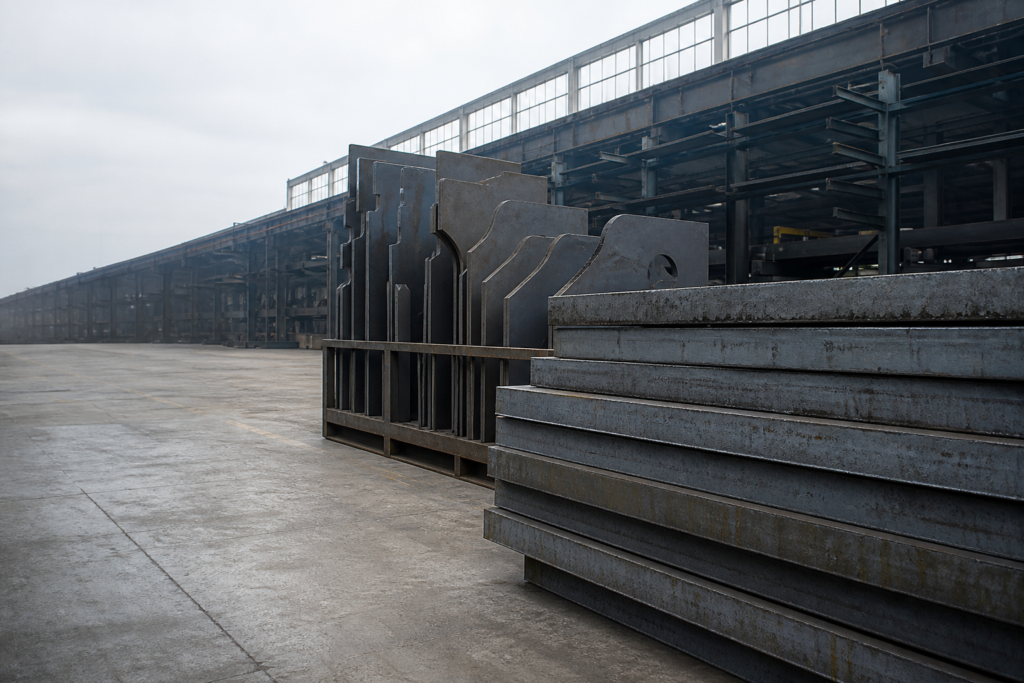
Steel plate cutting parts move the specification one step upstream: the plate arrives profiled, so nobody has to receive it, mark it, cut it and re-handle it — which matters more, not less, when the plate is thick and high strength. Our range includes beveled CNC-cut parts up to 260 mm thick in grades such as SXQ500D-Z35, Q345 and EQ51 for energy equipment. See the 260 mm thick hot rolled plate cutting parts page and the steel plate cutting parts category.
Wear-resistant grades and coated coil
Where the duty is abrasion rather than structure — buckets, chutes, hoppers, liners — the list runs from NM360 through NM400, NM450, NM500 and NM600; see the wear-resistant steel plate page. One source can also cover the rest of a structure: cold rolled steel coil for switchgear cabinets and appliance panels, in commercial grades such as SPCC/DC01 and subject to mill availability; galvanized steel coil for outdoor housings; prepainted steel coil for cladding; and CRGO electrical steel for laminations. See the cold rolled steel sheet and coil, galvanized and electrical steel categories.
The exporter’s view: three judgements from the loading bay
1. Put flatness and residual stress in the enquiry, not on the complaint list. A mill spends on levelling control because these are process outcomes rather than accessories: if the drawing specifies a tight flatness tolerance, say so when you ask for the offer, because it changes which mill and which route can be quoted.
2. “Capacity coming back” is not capacity you can book. Ten million tonnes returning and €3.4 billion of decisions are good news, but EUROFER calls them stabilisation, and 0.1% demand growth does not create open rolling slots. Establish what the mill can roll and when it can ship before discussing the price per tonne. Everything we quote is a commonly supplied item and remains subject to mill availability.
3. Price the whole landed cost, not the CIF number. The Italian market split because buyers were comparing a material price against a total cost including duty risk, CBAM exposure, port financing and time. Where tonnage moves through a quota, the cheaper offer is not always the lower cost.
Getting the specification right
Planning fourth-quarter or first-quarter tonnage in heavy plate, plate cut to drawing, hot rolled, cold rolled or coated coil? Send us the grade, thickness, width, quantity and end application, and we will confirm what is rollable and what the documentation package contains. See our product list and company profile, or send enquiries through the contact page.
Sources
- Kallanish via EUROMETAL — “Dillinger France invests in Dunkirk plate mill”, 14 October 2026
- McCloskey by OPIS via EUROMETAL — “European heavy plate round-up”, 12 October 2026
- SteelRadar via EUROMETAL — “European steel industry brings 10 million tons of capacity back”, 14 October 2026
- Fastmarkets via EUROMETAL — “Trading remains muted in European domestic HRC market”, 14 October 2026
- Kallanish via EUROMETAL — “Italian coil buyers split over HRC import risks”, 14 October 2026