
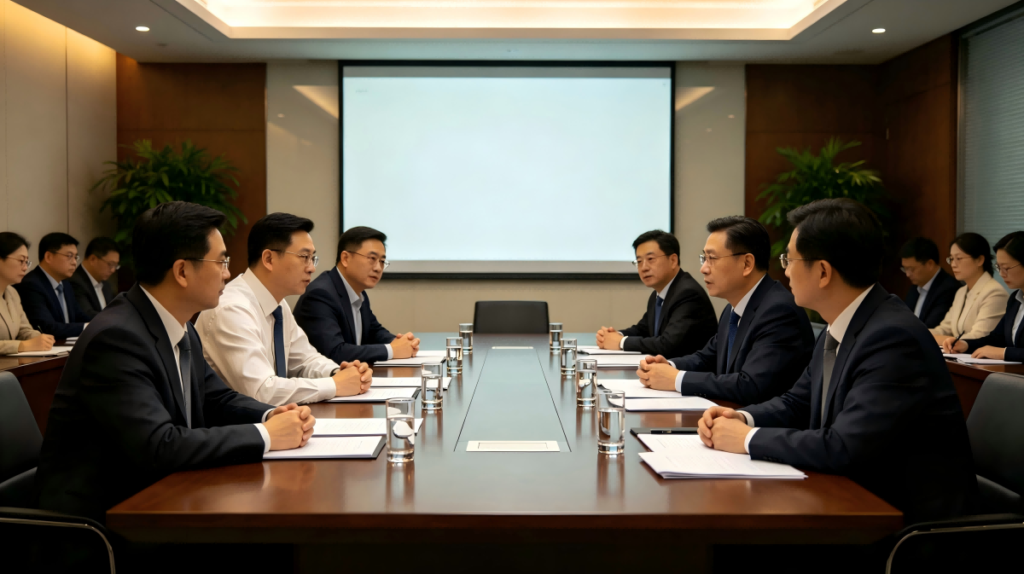
The kick-off meeting for the mandatory national standard Hot Rolled H-section Steel for Building Structures was held in Beijing.
Source: https://www.steelhome.com/detailspage.php?nid=4710078&ntype=n
On June 15, the kick-off meeting for the mandatory national standard Hot Rolled H-section Steel for Building Structures was held in Beijing. This meeting marked the official launch of the development of China’s first mandatory national standard for hot rolled H-section steel used in the construction sector. It will set a solid baseline for the quality and safety of steel materials for building structures, and provide standard support for the coordinated development of the entire industrial chain.
At the meeting, Xia Nong, Vice President of the China Iron and Steel Association (CISA); Pan Beichen, First-Level Research Fellow of the Standards and Technology Administration Department under the State Administration for Market Regulation; Wang Ke, Second-Level Principal Staff Member of the Raw Materials Industry Department of the Ministry of Industry and Information Technology; and Ma Xinbo, Director of the Science and Technology & Industrialization Development Center of the Ministry of Housing and Urban-Rural Development, delivered speeches successively. Zhang Longqiang, Secretary of the Party Committee and President of the China Metallurgical Industry Information and Standardization Research Institute, addressed the gathering. Wu Baoqiao, Engineering Scientist from China Baowu Steel Group, introduced the formulation background and progress of the standard. Wang Bin, Deputy Secretary-General of CISA and Director of the Planning and Development Department, and other attendees were present. Cheng Ding, Chairman of the Section Steel Sub-Committee of the National Steel Standardization Technical Committee, presided over the meeting and delivered a concluding speech.
Xia Nong stated that hot rolled H-section steel is a primary load-bearing structural material for steel buildings, widely applied in civil buildings, industrial buildings, municipal facilities, urban renewal and other major projects. Its specifications and standard requirements are directly linked to project quality and safety, the development level of the industrial chain, and the progress of green and low-carbon transformation. Therefore, formulating and implementing this mandatory national standard is an inevitable choice for the iron and steel industry to meet the demand for high-quality development of the construction industry, standardize market order, and advance the high-end, intelligent and green development of hot rolled H-section steel. It is an effective measure to shore up weaknesses in standards for construction steel structures, drive industrial upgrading, and facilitate the new-type industrialization of the construction sector. It also represents an objective requirement for the iron and steel and construction industries to collaborate and integrate, so as to improve the overall quality and comprehensive competitiveness of the whole industrial chain.
He pointed out that the standard formulation shall adhere to the principles of goal-oriented and problem-oriented approaches, comply with the requirements for high-quality development and the trend of industrial upgrading, prioritize downstream demands and the integrated development of the whole industrial chain, promote collaboration among enterprises, universities, research institutions and end-users, and uphold pragmatism, openness and innovation. Five key tasks need to be accomplished. First, optimize the specification system of hot rolled H-section steel following the principle of fewer specifications, diversified combinations and higher efficiency. Second, strictly control tolerance indicators to narrow the range of product quality fluctuations, and enhance the stability, consistency and reliability of hot rolled H-section steel products. Third, drive the upgrading of steel quality, gradually phase out steel grades with low strength, poor performance and low adaptability, and advance H-section steel toward high strength, high toughness and high durability. Fourth, accelerate the formulation work on the premise of scientific content and sufficient demonstration. Fifth, carry out supporting work for standard implementation in parallel, covering material selection, design, construction and acceptance, so as to deliver clear, specific and implementable technical guidance for engineering applications.
Zhang Longqiang noted that a relatively complete standard system has been established for H-section steel, covering general basic standards, seismic resistance, weather resistance, galvanization, stainless steel, composite materials and other categories. The development of this mandatory national standard is a major initiative of the National Steel Standardization Technical Committee to implement the requirement of accelerating the development of coordinated and unified mandatory national standards, and reinforcing the bottom line for protecting personal health, life and property safety as well as ecological and environmental safety. It also serves as an important supplement to the existing standard system for hot rolled H-section steel. As the secretariat of the technical committee, his institute will focus on three aspects: strengthening organizational coordination to ensure efficient progress, maintaining scientific rigor to guarantee standard quality, and enhancing communication and cooperation to pool wisdom from all parties.
Wu Baoqiao explained that manufacturers of hot rolled H-section steel are currently subject to production constraints and lack accumulated experience in follow-up assembly processes and technologies, making it difficult to expand into broader end-user markets. Meanwhile, steel structure processing enterprises have insufficient understanding of the properties and application advantages of hot rolled H-section steel, incurring additional adaptation and transformation costs in subsequent processing. As a result, a mutually beneficial win-win model has not been formed in product application between the two sides. He added that the formulation of this mandatory national standard will resolve the problem of mismatched standards across the industrial chain, shorten the supply-demand cycle, cut production costs, boost the efficient application of hot rolled H-section steel, drive the coordinated upgrading of upstream and downstream sectors, and advance the green and high-quality development of the steel structure industry.
Subsequently, representatives from all participating units discussed the framework and core technical indicators of the Draft of Hot Rolled H-section Steel for Building Structures, exchanged views and put forward relevant suggestions.
In the months prior to the meeting, the standard compilation team conducted field investigations at 25 institutions, including architectural design institutes, steel structure processing enterprises, steel producers, specialized universities, the Science and Technology & Industrialization Development Center of the Ministry of Housing and Urban-Rural Development, and the China Steel Construction Society. The team collected opinions on applicable steel grades, models, specifications and dimensional tolerances of hot rolled H-section steel for building structure applications.