
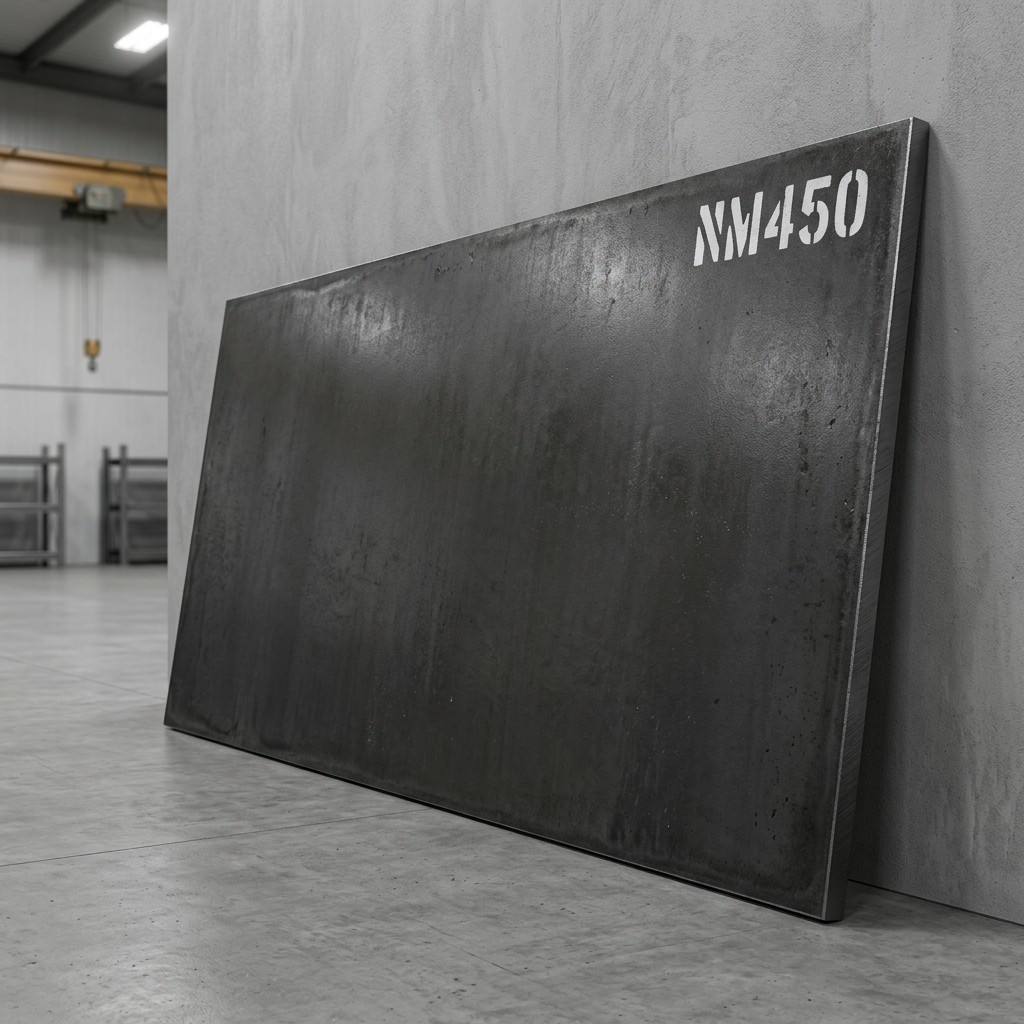
Wind Turbine Yaw Brake Discs: Why NM460N Beats Hardox 450 in Cold Climates
Short answer
For yaw brake discs in cold-climate wind farms, NM460N is the better material choice than Hardox 450, because it delivers a comparable 460 HBW hardness while retaining impact energy of 27 J or higher at −40 °C. Hardox 450 offers the same hardness class but has limited low-temperature impact performance, which is exactly the failure mode that matters on a Siberian or Arctic site.
The second question buyers ask is not “which grade” but “who can deliver it already cut, bevelled, inspected and traceable.” That is where Nanjing Tiange Metal Trading operates — we are a NISCO-backed specialty steel supplier that coordinates sourcing across both NISCO and Xingcheng Special Steel resources, and we fabricate to ±1 mm tolerance in-house.
Why the yaw brake disc is the most underrated part on a wind turbine
The yaw system holds the nacelle into the wind. When the wind shifts, the yaw drives release and the brake disc absorbs the load. That means the disc lives in a double duty cycle:
- Abrasion — repeated braking against the yaw caliper, thousands of cycles per year.
- Low-temperature embrittlement — at −40 °C, a steel that is merely hard becomes a steel that cracks.
Most procurement documents specify “wear-resistant plate, 450 HBW class” and stop there. That specification is what causes premature disc failure in cold climates, because the 450 HBW class contains materials with very different low-temperature behaviour.
NM460N vs Hardox 450 vs S460N: the actual comparison
This table is the core of the decision. It is also the table we recommend attaching directly to a technical clarification request.
| Property | NM460N | Hardox 450 | S460N |
|---|---|---|---|
| Hardness | 460 HBW | 450 HBW | — (not a wear grade) |
| Impact energy at −40 °C | ≥ 27 J | Limited low-temp impact performance | — |
| Wear resistance | High | High | None |
| Yield strength | — | — | 460 MPa |
| Machinability | Excellent | Moderate | Excellent |
| Typical use | Yaw brake discs, cold-climate wear parts | General wear plate | Structural, non-wear |
The key column is the second row. A 450 HBW plate that embrittles at −40 °C is a false economy: the disc may pass the first year and fail in the third winter, and the replacement cost on an operating turbine is an order of magnitude above the material cost.
The way to avoid that is decided at enquiry stage, not at goods-in. Specify the minimum operating temperature, the impact energy requirement at that temperature, and the acceptance level for ultrasonic testing. A supplier who cannot answer all three in writing is a supplier who is selling plate, not material performance.
From plate to finished disc: how ±1 mm tolerance is actually achieved
Buying the right grade is half the job. The other half is dimensional control, and this is where most traders drop out — they sell plate, and the customer then has to find a fabricator, re-inspect, and take responsibility for a chain they do not control.
Nanjing Tiange runs the full chain internally:
- 20,000 W fibre laser cutting — high-power output is what allows thick wear plate to be cut with a narrow heat-affected zone, which matters for NM460N because excessive thermal input degrades the hardness at the cut edge.
- CNC flame cutting — for thicknesses and contours where flame cutting is more economical.
- Precision bevel milling — the mating face of a brake disc has to sit flat against the hub; this is where tolerance is won or lost.
- Large-scale shot blasting — removes scale and prepares the surface consistently before inspection and coating.
- Dimensional verification — every batch is checked on a 3D coordinate measuring system, not by sample.
The delivered result is ±1 mm tolerance and surface roughness Ra < 6.3, evidenced on a 3D coordinate measuring system rather than signed off by eye.
The quality loop: five checks that travel with the goods
Cold-climate wind projects are audited, and auditors ask for evidence, not assurances. Every order from our workshop carries:
| # | Check | What it proves |
|---|---|---|
| 1 | UT S2 E2 ultrasonic testing (mandatory) | Internal soundness — no laminations or inclusions hiding under a hard surface |
| 2 | On-site hardness testing | The 460 HBW claim is verified on your parts, not just on the mill certificate |
| 3 | Metallographic analysis | Microstructure is consistent after cutting and any thermal processing |
| 4 | 3D coordinate dimension verification, every batch | Geometry, not a sample of geometry |
| 5 | Original heat number tracking + MTC 3.1 | The plate in your yard is traceable to the original mill heat |
Point 5 is the one that separates a real supplier from a reseller. An EN 10204 3.1 certificate issued against the original heat is worth more than a stack of generic test reports, because it can be cross-checked against the mill’s own record for that heat.
Supply, compliance and logistics for Russian and CIS projects
Wind projects in Russia and the CIS add three requirements that Western suppliers often cannot meet.
Russian-language technical passports. Documentation must comply with GOST 2.601. We issue technical passports in Russian, so your engineering team can accept the material without a translation round-trip.
Payment settlement. We settle through the VTB Shanghai Branch, keeping the transaction inside a channel established for this trade corridor and reducing sanction-related exposure. Which settlement route applies to a specific order is confirmed case by case with our commercial team before the contract is signed.
Export continuity. Export licensing is secured through 2026, so a multi-phase project does not stall between phases.
Logistics. Cargo moves on the Nanjing CR Express route to Manzhouli and on to major Russian ports and warehouses. Packaging is designed for that route, not for a domestic truck: VCI vapour corrosion inhibitor, moisture-proof industrial wrapping, and cross-reinforced wooden pallets that resist rail handling rather than only forklift handling.
Remote factory inspection. Your engineers do not have to fly in to qualify us. Online plant audits can be arranged on request, and our team will confirm the walkthrough scope and a time slot that fits your working hours.
Frequently asked questions
Is NM460N a direct replacement for Hardox 450? In the 450–460 HBW class they are interchangeable on hardness, but not on low-temperature toughness. For cold-climate yaw brake discs, NM460N is the safer substitution; for ambient-temperature general wear, either works.
Can NM460N be welded? Yes, but not like mild steel. Wear-resistant grades have to be welded with controlled heat input so that the hardness of the heat-affected zone is not destroyed, and the preheat and interpass temperature have to be set for the actual grade and thickness. Our technical team issues the welding parameters together with the order documents.
What thickness range do you cover? Wear-resistant plate for yaw brake discs and comparable components is supplied in the plate thicknesses the part requires. Because availability depends on both the grade and the mill source, we confirm the exact range against your drawing before quoting — so that the answer you receive is a confirmed one, not a catalogue range.
What is the lead time? Lead time is driven by two stages: allocating the specified heat, and completing fabrication plus inspection. Send the drawing and the required quantity and we will confirm a delivery date against the mill source we would lock for that order.
Do you supply the full disc or just the plate? We supply finished, inspected parts — cut, bevelled, blasted and dimensionally verified — with the heat number traceable back to the original mill.
Get a material and fabrication quote
Send us the drawing, the minimum operating temperature, and the destination country. We will come back with a material recommendation, the fabrication route, and the documentation set that will travel with the goods.
Nanjing Tiange Metal Trading Co., Ltd. Email: postmaster@tigosteel.com Phone / WhatsApp / Telegram: +86 138 1389 7227 Web: www.tigosteel.com Nanjing, Jiangsu, China